
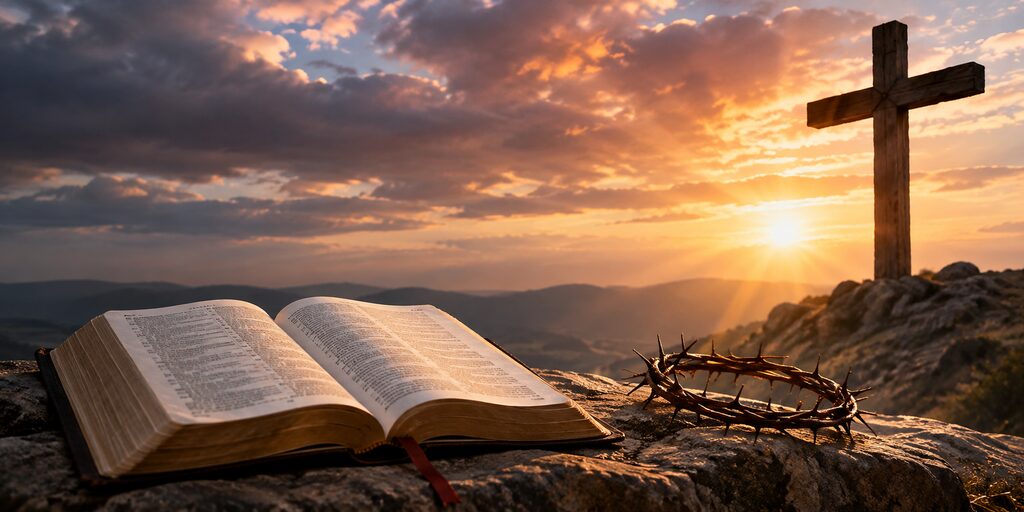
WHEN RELIGIOUS TRADITION CHALLENGES BIBLICAL TRUTH
A Scriptural Examination of Roman Catholic Doctrine
Primary Scripture: Colossians 2:8–10 (NKJV)
The teaching will follow a logical progression, beginning with the question of authority and then examining salvation, the papacy, priesthood, Christ’s sacrifice, Mary, purgatory, and religious practices. Each section will explain the Catholic position fairly, examine relevant biblical passages, and present the scriptural reasons for disagreement.
The central theme throughout will be that Christ’s finished work is sufficient for our justification, and no religious institution or practice can add to what He has accomplished.
Introduction: When Tradition Challenges the Truth of God’s Word
Throughout the centuries, Christianity has been surrounded by religious traditions, established institutions, theological systems, and practices intended to guide people in their relationship with God. Some have served useful purposes in teaching biblical truth, encouraging worship, and preserving the historical testimony of the Christian faith. Others have introduced questions concerning the authority of Scripture, the nature of salvation, and the sufficiency of Jesus Christ.
The existence of religious tradition is not itself the problem. Scripture recognizes the importance of faithfully preserving apostolic teaching (2 Thessalonians 2:15). The concern arises when religious teachings or practices are presented as binding upon believers without sufficient biblical foundation, or when they appear to introduce requirements beyond what Scripture establishes for salvation.
The apostle Paul warned the believers at Colossae:
“Beware lest anyone cheat you through philosophy and empty deceit, according to the tradition of men, according to the basic principles of the world, and not according to Christ.” — Colossians 2:8, NKJV
Paul’s warning directs our attention to a fundamental question: Does a particular teaching originate from the truth revealed by God, or does it depend upon the authority of human religious tradition?
That question deserves careful consideration, especially when examining doctrines that have become deeply established within Christianity.
Roman Catholicism represents one of the oldest and most influential traditions within professing Christianity. It affirms many foundational Christian truths, including the Trinity, the deity of Jesus Christ, His virgin birth, His sacrificial death, His bodily resurrection, and the necessity of God’s grace for salvation.
These affirmations should be acknowledged.
However, Roman Catholicism also teaches doctrines concerning the authority of the Church, the papacy, justification, the sacraments, the priesthood, the intercession of Mary and the saints, and purification after death. These teachings raise important questions when examined through the understanding of Scripture presented in this study.
Catholics generally do not regard these doctrines as additions to the gospel. Rather, they understand them as faithful expressions of apostolic teaching preserved and interpreted by the Church. Nevertheless, the question remains whether these doctrines can be established from Scripture and whether they are consistent with the biblical teaching concerning salvation through Jesus Christ.
This examination is not intended to condemn Catholic individuals, question their sincerity, or suggest that everyone associated with the Roman Catholic Church holds identical personal beliefs. Many Catholics sincerely profess faith in Jesus Christ and desire to honor God.
Neither should we assume that everyone identifying as Protestant or evangelical has personally trusted Jesus Christ for salvation. Religious identification, church membership, and participation in religious activities do not, by themselves, establish saving faith.
The issue before us is not the sincerity of religious devotion, but the truthfulness of the doctrines being taught.
We must also recognize that the same biblical standard applies to every Christian denomination, ministry, and religious organization, including PATH Ministry. No religious institution possesses the authority to place its teachings beyond examination by the written Word of God.
The Bereans provide an important example. When Paul and Silas preached in Berea, the people received the message willingly but examined the Scriptures daily to determine whether what they were hearing was true (Acts 17:10–12).
Their example reminds us that biblical truth should never be accepted merely because it is proclaimed by a respected religious leader, supported by a longstanding tradition, or endorsed by an influential institution.
The authority of a teaching must ultimately rest upon its faithfulness to God’s Word.
At the center of this examination stands the person and finished work of Jesus Christ.
Scripture declares that salvation is by grace through faith, apart from human works (Ephesians 2:8–9). It identifies Jesus Christ as the one mediator between God and humanity (1 Timothy 2:5). It teaches that His sacrifice was offered once for all (Hebrews 10:10–14), and that believers are justified through faith in Him (Romans 5:1).
These truths lead us to the central question of this study:
Is Jesus Christ, and what He accomplished through His death and resurrection, entirely sufficient for our salvation, or must additional religious requirements contribute to our acceptance before God?
Our purpose is to examine that question carefully, comparing specific Roman Catholic doctrines with Scripture, acknowledging what Catholicism actually teaches, and explaining why we believe certain doctrines are inconsistent with the biblical gospel.
We will not attempt to resolve these disagreements through religious prejudice, historical accusations, or appeals to denominational loyalty. Instead, we will consider the relevant biblical passages in their context and seek to understand what God has revealed concerning His Son and the salvation He provides.
Ultimately, this study is about something far greater than the differences between Catholicism and Protestantism.
It is about the sufficiency of Jesus Christ.
For if righteousness could be obtained through religious observance, sacramental participation, or human achievement, we must consider the implications of Paul’s declaration in Galatians 2:21: Christ died in vain if righteousness comes through the law.
But if Christ has fully accomplished what is necessary for our justification before God, then our confidence must rest in Him rather than in any religious system.
The question is not whether we have faithfully practiced a religion. The question is whether we have personally trusted Jesus Christ and His finished work for our salvation. That is the question we must answer as we turn to the Scriptures.
Section 1: Who Has the Final Authority—Scripture or Religious Tradition?
Primary Scripture: 2 Timothy 3:16–17; Acts 17:10–12; Mark 7:6–13
Before examining the individual doctrines of Roman Catholicism, we must establish the standard by which those doctrines will be evaluated.
This is foundational because disagreements concerning salvation, the sacraments, the priesthood, Mary, and the authority of the Church ultimately lead us back to one essential question:
Who has the final authority to determine what Christians must believe—the written Word of God or the teachings and traditions of a religious institution?
Understanding the Roman Catholic Position
Roman Catholicism teaches that God’s revelation has been entrusted to the Church through Sacred Scripture and Sacred Tradition, with the Magisterium serving as the Church’s authoritative teaching office.
According to Catholic teaching, Scripture and Sacred Tradition are not competing sources of divine truth. Rather, they are understood as closely connected means through which the apostolic faith has been preserved and transmitted.
The Magisterium, consisting of the pope and the bishops in communion with him, is regarded as having the responsibility to authentically interpret God’s Word.
Catholicism does not officially teach that the Magisterium stands above the Word of God. The Catechism of the Catholic Church, paragraph 86, explicitly states that the teaching office is its servant.
Nevertheless, Catholic doctrine also maintains that the Church possesses an authoritative role in interpreting divine revelation and defining doctrines that Catholics are obligated to accept.
This creates an important theological disagreement.
If a doctrine is declared binding by the Church, but cannot be clearly demonstrated from Scripture, on what basis must a Christian accept it?
What Does Scripture Say About Its Own Authority?
The apostle Paul wrote:
“All Scripture is given by inspiration of God, and is profitable for doctrine, for reproof, for correction, for instruction in righteousness, that the man of God may be complete, thoroughly equipped for every good work.” – 2 Timothy 3:16-17 (NKJV)
Paul establishes two essential truths concerning Scripture: its divine origin and its sufficiency for equipping believers in righteousness and faithful service to God.
First, Scripture is inspired by God. Its authority does not originate with religious institutions, councils, or human leaders. Scripture carries divine authority because God Himself is its ultimate source.
Second, Paul declares that Scripture is profitable for doctrine, correction, and instruction in righteousness, so that the servant of God may be complete and thoroughly equipped for every good work.
This does not mean that pastors, teachers, or church leadership have no legitimate role in the Christian life. Scripture itself establishes the importance of faithful teaching and spiritual leadership (Ephesians 4:11–13).
Neither does this passage explicitly state that every Christian doctrine must be established from Scripture alone. Rather, it establishes the divine authority and equipping sufficiency of Scripture. The Protestant understanding of sola Scriptura draws upon this passage together with other biblical teachings concerning the authority of God’s Word.
The central principle is that no human teaching possesses the inherent authority of divinely inspired Scripture.
The Bereans: An Example Worth Following
When Paul and Silas arrived in Berea, the people demonstrated an attitude toward biblical teaching that remains important today.
Acts 17:11 describes the Bereans as receiving the message with readiness while examining the Scriptures daily to determine whether the things being taught were true.
Consider the significance of their actions.
These individuals were listening to the apostle Paul, a man personally commissioned by Jesus Christ to proclaim the gospel. Yet they examined his message against the Scriptures.
Luke commends their response rather than criticizing it.
The Bereans were not rejecting spiritual authority or refusing to learn from qualified teachers. They were demonstrating that even religious teaching presented with considerable authority should be examined in light of God’s revealed Word.
If the Bereans were commended for examining Paul’s preaching against Scripture, how much more should believers carefully examine the teachings of religious institutions and traditions that developed throughout subsequent centuries?
Faithful biblical teaching should welcome examination by Scripture rather than discourage it.
When Religious Tradition Conflicts With God’s Word
Jesus Himself confronted religious leaders who elevated human traditions in ways that undermined God’s commandments.
In Mark 7:6–13, Jesus rebuked the Pharisees and scribes for allowing their traditions to interfere with obedience to God’s Word.
The issue was not simply that they possessed traditions. The problem was that certain traditions had been given such authority that they effectively displaced what God had commanded.
Jesus identified this danger when He said:
“making the word of God of no effect through your tradition which you have handed down. And many such things you do.” — Mark 7:13 (NKJV)
This warning remains relevant to every religious tradition.
A practice does not become divinely authoritative merely because it has existed for centuries. Neither does widespread acceptance among religious leaders establish that a doctrine originated with God.
However, we must also recognize that Scripture does not condemn every tradition. Paul instructed believers to hold firmly to the apostolic teachings they had received (2 Thessalonians 2:15).
The important distinction is between authentic apostolic teaching and religious traditions that cannot be demonstrated to faithfully preserve that teaching.
Roman Catholicism maintains that Sacred Tradition preserves genuine apostolic teaching. The Protestant position presented here is that the written Scriptures provide the final, infallible standard by which such claims must be evaluated.
Does the Church Have Authority Over Scripture?
The Church has an important responsibility to teach, preserve, proclaim, and faithfully interpret the Scriptures.
However, there is a difference between recognizing the Church’s responsibility to teach God’s Word and accepting that its doctrinal interpretations are themselves infallible.
Roman Catholicism teaches that the Magisterium can exercise infallibility under particular conditions when definitively teaching matters of faith and morals.
The Protestant position presented in this study rejects the claim that any continuing ecclesiastical office possesses such an infallible teaching authority.
This does not mean that individual believers are incapable of misunderstanding Scripture. Nor does it mean that every Protestant interpretation is necessarily correct.
Rather, it means that all interpretations, including those advanced by respected theologians, pastors, councils, and denominations, remain subject to examination by the written Word of God.
The Church is called to submit to God’s revelation, not to establish doctrines that possess independent divine authority.
The Biblical Principle: God’s Word Is Our Final Authority
The question of religious authority must be settled before we can properly examine the remaining doctrines in this study.
If a religious institution possesses authority to define binding doctrines beyond what can be established from Scripture, then the institution’s teaching authority becomes essential to determining what Christians must believe.
But if Scripture is the final, infallible standard for Christian faith and doctrine, then every teaching must be evaluated according to its faithfulness to God’s written revelation.
This standard applies equally to Roman Catholicism, Protestantism, Pentecostalism, independent churches, and PATH Ministry.
No ministry is exempt from biblical examination.
Our responsibility is not to defend a religious tradition simply because it is familiar, longstanding, or widely accepted. Our responsibility is to believe and faithfully proclaim what God has revealed in His Word.
As we continue this study, that principle will guide our examination of the papacy, justification, the sacraments, the priesthood, and other doctrines associated with Roman Catholicism.
The question we must continually ask is this: Does Scripture establish this teaching, or are we being asked to accept it primarily upon the authority of religious tradition?
That distinction provides the foundation for everything that follows.
Section 2: The Papacy and Apostolic Succession—Did Christ Establish a Continuing Supreme Authority Over His Church?
Primary Scripture: Matthew 16:13–19; Ephesians 2:19–22; 1 Peter 2:4–8; Colossians 1:18
Having established the authority of Scripture as the foundation for examining Christian doctrine, we must now consider one of the central claims of Roman Catholicism: that Jesus Christ established the apostle Peter as the visible head of His Church and that Peter’s authority continues through an unbroken succession of bishops of Rome, commonly known as popes.
This doctrine is foundational to the Roman Catholic understanding of church authority. If the papacy was established by Jesus Christ, then its claims deserve serious consideration. But if Scripture does not establish a continuing office of supreme authority over the universal Church, then those claims must be carefully questioned.
The central question is this: Did Jesus Christ establish Peter and his successors as the supreme earthly authority over His Church, or does Scripture identify Christ Himself as the Church’s continuing and ultimate Head?
Understanding the Roman Catholic Position
Roman Catholicism teaches that Jesus Christ gave the apostle Peter a unique position of leadership among the apostles.
According to Catholic doctrine, Peter became the first bishop of Rome, and his successors inherited a continuing responsibility to shepherd and govern the universal Church.
The pope is therefore regarded as the successor of Peter, the bishop of Rome, and the visible principle of unity within the Catholic Church.
Catholic teaching also distinguishes the pope’s ordinary teaching and governing authority from the specific circumstances under which papal infallibility is claimed.
Papal infallibility does not mean that the pope is sinless, incapable of making mistakes, or correct in every statement he makes. Rather, Catholic doctrine teaches that the pope is preserved from error when, under particular conditions, he definitively proclaims a doctrine concerning faith or morals to be held by the whole Church.
The principal biblical passage used to support the papacy is Matthew 16:18–19.
What Did Jesus Mean When He Said, “On This Rock I Will Build My Church”?
In Matthew 16:13–19, Jesus questioned His disciples concerning His identity.
When Jesus asked who they believed Him to be, Peter answered:
“You are the Christ, the Son of the living God.” — Matthew 16:16 (NKJV)
Jesus then responded by blessing Peter and explaining that this revelation had come from the Father rather than from human understanding.
In Matthew 16:18–19, Jesus spoke of Peter, the rock upon which He would build His Church, the keys of the kingdom of heaven, and the authority of binding and loosing.
Roman Catholicism understands this passage as establishing Peter’s unique leadership and the foundation for the continuing papal office.
However, several important distinctions must be considered.
First, Jesus was responding to Peter’s confession concerning His identity as the Christ, the Son of the living God.
Second, the passage unquestionably gives Peter an important role in the establishment of the early Church. Peter was prominent among the apostles, preached at Pentecost, and played a significant role in the early expansion of the gospel (Acts 2; Acts 10).
Third, Christians have historically differed concerning the meaning of the rock in Matthew 16:18. Some understand it as Peter himself, others as Peter’s confession, and others emphasize Christ as the ultimate foundation.
Even if we understand Peter to be the rock in the immediate context, the passage does not explicitly establish that Peter’s authority would be transferred to a continuing succession of bishops of Rome possessing supreme jurisdiction over the universal Church.
That distinction is essential.
Recognizing Peter’s significant apostolic role is not the same as accepting every later claim associated with the papacy.
Who Is the Foundation and Head of the Church?
Scripture repeatedly identifies Jesus Christ as the essential foundation and supreme Head of His Church.
The apostle Paul explained in Ephesians 2:19–22 that believers are members of God’s household, built upon the foundation of the apostles and prophets, with Jesus Christ Himself as the chief cornerstone.
This passage acknowledges the foundational role of the apostles collectively while giving Christ the position of supreme importance.
Likewise, Peter himself described Jesus Christ as the chosen and precious cornerstone in 1 Peter 2:4–8.
Peter did not present himself as the ultimate foundation upon which the Church’s existence depended. Instead, he directed believers toward Jesus Christ.
The apostle Paul also wrote:
“And He is the head of the body, the church, who is the beginning, the firstborn from the dead, that in all things He may have the preeminence.” — Colossians 1:18 (NKJV)
This declaration is central to our understanding of church authority.
Jesus Christ is not merely the historical founder of the Church. He remains its living Head.
Roman Catholicism also affirms that Christ is the supreme Head of the Church, while understanding the pope as His visible representative. Therefore, the disagreement is not whether Christ is Head, but whether Scripture establishes the particular continuing office and authority claimed for the pope.
The biblical question is whether Christ appointed a succession of men to exercise universal jurisdiction over His Church, or whether the apostles’ foundational authority was unique to their original calling.
Does Scripture Establish Apostolic Succession?
The apostles held a unique position in the establishment of the Church.
They were personally commissioned by Jesus Christ, entrusted with proclaiming His resurrection, and appointed to establish the foundational teaching upon which the Church would be built.
Scripture also teaches the importance of faithful leadership continuing from one generation to another.
Paul instructed Timothy to entrust sound teaching to faithful men who would be able to teach others (2 Timothy 2:2). The New Testament likewise establishes qualifications for elders and overseers who shepherd local congregations (1 Timothy 3:1–7; Titus 1:5–9).
These passages support the continuation of faithful teaching and spiritual leadership.
However, the continuation of biblical leadership is not necessarily the same as the continuation of the apostles’ unique foundational authority.
In Acts 1:15–26, Matthias was selected to replace Judas Iscariot among the Twelve. This event demonstrates that an apostolic vacancy was filled under particular circumstances.
Nevertheless, Scripture does not explicitly establish an ongoing succession of replacements for every apostle or identify the bishops of Rome as inheritors of Peter’s universal authority.
Catholicism appeals to Scripture and its understanding of apostolic Tradition in support of this succession. The Protestant position presented here is that these claims have not been sufficiently established by the written Word of God.
The Church must preserve apostolic doctrine, but preserving that doctrine does not require accepting that later religious leaders possess the same authority as the apostles themselves.
What About the Keys of the Kingdom?
Jesus told Peter that He would give him the keys of the kingdom of heaven (Matthew 16:19).
Catholic teaching understands these keys as representing a particular governing authority entrusted to Peter and continued through his successors.
The imagery of keys does indicate authority, and Peter’s role in opening the proclamation of the gospel to Jews and Gentiles is significant.
However, we should also consider Matthew 18:18, where Jesus speaks to His disciples concerning binding and loosing in the context of church discipline.
This demonstrates that authority relating to the administration and discipline of the Church was not described exclusively in connection with Peter.
Furthermore, in John 20:21–23, the risen Christ commissioned His disciples and spoke concerning the forgiveness and retention of sins.
These passages show that Christ entrusted genuine responsibilities to His apostles.
Yet they do not explicitly establish a continuing papal office possessing supreme authority over every Christian congregation.
The authority Christ entrusted to His apostles must be understood according to what Scripture actually teaches, rather than assuming that every later institutional claim necessarily follows from that authority.
Did Peter Exercise Supreme Authority Over the Other Apostles?
Peter clearly occupied a prominent position among the apostles.
He frequently spoke on their behalf, preached at Pentecost, and participated in significant decisions during the early development of the Church.
However, the New Testament also records occasions demonstrating that Peter was not beyond correction.
In Galatians 2:11–14, Paul publicly confronted Peter at Antioch because Peter’s conduct was inconsistent with the truth of the gospel.
This event does not, by itself, disprove the Catholic doctrine of papal infallibility, since Catholicism does not claim that popes are incapable of personal sin or mistaken conduct.
Nevertheless, it demonstrates that Peter’s conduct was accountable to the truth of the gospel.
Acts 15 also records the Jerusalem Council, where the apostles and elders considered the question of whether Gentile believers were required to observe the Law of Moses.
Peter contributed significantly to the discussion, but the account also records the involvement of other apostles and elders, including James, who presented the concluding judgment reflected in the council’s letter.
These passages portray the early Church exercising leadership through apostolic teaching, deliberation, and submission to God’s revealed purposes.
They do not clearly demonstrate the later model of universal papal jurisdiction taught by Roman Catholicism.
The Biblical Principle: Christ Alone Is the Supreme Head of His Church
The New Testament establishes the importance of spiritual leadership, faithful teaching, church discipline, and accountability within the body of Christ.
Pastors and elders have genuine responsibilities to shepherd God’s people, protect sound doctrine, and provide biblical instruction.
However, their authority is ministerial rather than independent. They are responsible for faithfully teaching and applying God’s Word.
Peter himself instructed church elders to shepherd the flock of God entrusted to them, not as those exercising domination over God’s people, but as examples to the flock (1 Peter 5:1–4).
He also identified Jesus Christ as the Chief Shepherd.
This is the authority structure we believe Scripture establishes.
Christ is the supreme Head of the Church. His apostles provided the foundational witness and teaching. Faithful leaders continue the responsibility of proclaiming and preserving that teaching, but no continuing office is explicitly established in Scripture as possessing universal and infallible authority over the Church.
Our rejection of the papacy is therefore not a rejection of legitimate church leadership. It is a rejection of the claim that Jesus Christ established a continuing supreme earthly office whose doctrinal authority binds the conscience of every Christian.
The Church belongs to Jesus Christ. He purchased it with His blood, sustains it through His power, and governs it according to His Word.
No religious leader, regardless of title or historical succession, can replace His authority.
As we continue examining Roman Catholic doctrine, we must remember that the question of church authority is not merely organizational. It affects how doctrines are established, how salvation is understood, and whether believers are ultimately directed toward the sufficiency of Christ or toward the authority of a religious institution.
The question is not whether Peter was an important apostle. Scripture clearly establishes that he was. The question is whether Jesus Christ established a continuing papal office with the authority claimed by Roman Catholicism. We do not believe Scripture establishes that claim.
Section 3: Is Salvation by Grace Alone Through Faith Alone?
Primary Scripture: Ephesians 2:8–10; Romans 3:21–28; Romans 4:1–8; Romans 5:1; Galatians 2:16
Having examined the authority of Scripture and the claims associated with the papacy, we now turn to what may be the most consequential doctrinal disagreement between Roman Catholicism and the biblical position presented in this study: How is a sinful person justified before a holy God?
This question reaches the very heart of the gospel.
Every person has sinned and stands in need of God’s forgiveness and righteousness (Romans 3:23). No amount of religious devotion, moral improvement, or human effort can erase the reality of sin or establish a righteousness sufficient to satisfy God’s perfect standard.
Yet Scripture declares that God has provided salvation through His Son, Jesus Christ.
The question is not whether salvation originates in God’s grace. Both Roman Catholicism and the Protestant understanding presented here affirm that salvation is impossible apart from God’s grace and the redeeming work of Jesus Christ.
The disagreement concerns how a sinner receives justification, what justification accomplishes, and whether justification rests entirely upon Christ’s righteousness received through faith or involves an ongoing process of inward renewal and sacramental participation.
Understanding the Roman Catholic Position
Roman Catholicism teaches that justification begins with God’s grace and is made possible through the saving work of Jesus Christ.
It does not officially teach that individuals can earn their initial justification through their own efforts or save themselves independently of God’s grace.
According to Catholic doctrine, justification includes both the forgiveness of sins and the inward renewal of the individual. Rather than understanding justification solely as God’s declaration that a sinner is righteous through faith in Christ, Catholic theology also understands it as a transformation through which a person is made righteous by God’s grace.
Catholicism teaches that baptism ordinarily serves as the sacramental means through which initial justification is received. It also teaches that sanctifying grace can be increased through faithful cooperation with God, particularly through participation in the sacraments and a life of faith working through love.
Catholic teaching further distinguishes between mortal and venial sins. Mortal sin, when committed with the necessary knowledge and deliberate consent, is understood to destroy sanctifying grace in the soul. The sacrament of reconciliation provides the ordinary means by which a baptized Catholic who has fallen into mortal sin is restored to grace.
Catholicism understands this entire process as dependent upon God’s grace rather than independent human achievement.
Nevertheless, these teachings raise an important biblical question.
Does Scripture present justification as God’s declaration of righteousness received through faith in Jesus Christ, or as a condition of righteousness that must be increased, preserved, and restored through sacramental participation and human cooperation?
What Does Scripture Teach About Justification?
The apostle Paul addressed justification extensively in his letters to the Romans and Galatians.
In Romans 3:21–28, Paul explains that God’s righteousness is revealed apart from the law and that sinners are justified freely by His grace through the redemption accomplished in Jesus Christ.
He concludes:
“Therefore we conclude that a man is justified by faith apart from the deeds of the law.” — Romans 3:28 (NKJV)
This declaration is foundational.
Paul does not present justification as a reward for religious achievement. Rather, he identifies faith in Jesus Christ as the means through which sinners receive the righteousness God provides.
The distinction is important because justification concerns our standing before God.
According to the understanding presented in this study, justification is God’s judicial declaration that a believing sinner is righteous in His sight, not because of personal righteousness, but because of the righteousness provided through Jesus Christ.
This does not mean that the believer immediately becomes morally perfect or ceases to struggle with sin.
It means that the believer’s acceptance before God rests upon Christ rather than upon personal spiritual achievement.
Paul reinforces this truth in Romans 5:1:
“Therefore, having been justified by faith, we have peace with God through our Lord Jesus Christ,” — Romans 5:1 (NKJV)
Notice that Paul speaks of believers as having been justified.
Their peace with God is presented as the result of justification through faith, not as a condition they must continually earn through religious performance.
Is Righteousness Earned or Credited Through Faith?
Romans 4 provides one of the clearest explanations of justification apart from works.
Paul uses Abraham as an example, explaining that Abraham believed God and that his faith was accounted to him for righteousness.
In Romans 4:4–5, Paul contrasts the principle of wages earned through work with righteousness credited through faith.
The distinction is between receiving something as a deserved payment and receiving something through faith in the God who justifies the ungodly.
Paul’s argument is significant because Abraham was counted righteous before the giving of the Mosaic Law and before receiving circumcision as a covenant sign.
His justification was not dependent upon completing a religious ceremony or establishing a record of personal obedience.
It rested upon believing God’s promise.
Paul further illustrates this principle through David, who described the blessedness of the person to whom God credits righteousness apart from works (Romans 4:6–8).
These examples establish a consistent biblical pattern.
Justification is received through faith, not earned through religious observance or personal achievement.
This is why the distinction between justification and sanctification is so important.
Justification and Sanctification Are Not the Same
Scripture teaches both justification and sanctification, but they must not be confused.
Justification concerns the believer’s righteous standing before God through faith in Jesus Christ.
Sanctification concerns God’s continuing work in the believer’s life, producing spiritual growth, obedience, and increasing conformity to the character of Christ.
Both are essential aspects of the Christian life, and both depend upon God’s grace.
However, they are not interchangeable.
Justification is not progressively earned through sanctification. Rather, sanctification follows salvation as God works within those who belong to Him.
The apostle Paul explained:
“For by grace you have been saved through faith, and that not of yourselves; it is the gift of God, not of works, lest anyone should boast.” — Ephesians 2:8–9 (NKJV)
Paul immediately continues in verse 10 by explaining that believers are God’s workmanship, created in Christ Jesus for good works.
The order is significant.
We are not saved because we perform good works. We are saved by God’s grace through faith, and good works are the intended result of that salvation.
This distinction protects the gospel from two opposite errors.
The first is legalism, which treats obedience and religious performance as the basis of acceptance before God.
The second is the mistaken belief that grace makes obedience and spiritual growth unimportant.
Scripture rejects both.
Good works are the proper fruit of salvation, not the basis upon which justification is received.
What Role Do the Sacraments Play in Salvation?
Roman Catholicism teaches that the sacraments are effective means through which God communicates grace.
Baptism, confirmation, the Eucharist, reconciliation, anointing of the sick, holy orders, and matrimony are recognized as the seven sacraments of the Catholic Church.
Catholic theology does not regard these practices as merely human attempts to earn salvation. Rather, it understands them as divinely instituted means through which Christ communicates His grace.
Nevertheless, we must ask whether Scripture establishes participation in these sacraments as necessary for obtaining, increasing, or restoring the justification of a believer.
Baptism and the Lord’s Supper are clearly established in the New Testament as important practices for the Christian Church.
Jesus commanded His disciples to baptize believers (Matthew 28:19–20), and He instituted the Lord’s Supper as a remembrance of His sacrificial death (Luke 22:19–20).
However, recognizing the biblical importance of these practices does not require accepting that they contribute to the believer’s justification before God.
In Acts 10:43–48, Peter proclaimed forgiveness of sins through faith in Jesus Christ. While he was speaking, the Holy Spirit fell upon those who heard the message, before they were baptized with water.
This account demonstrates that God granted the Holy Spirit to believing Gentiles prior to their water baptism.
The passage does not diminish the importance of baptism, which Peter subsequently commanded. Rather, it demonstrates that their reception of the Spirit was not dependent upon first completing the ceremony.
Similarly, Scripture does not present the ongoing participation in a sacramental system as the means through which the believer’s righteous standing before God must be continually maintained.
Our confidence must remain in Christ’s completed redemption rather than in our ability to faithfully participate in religious ceremonies.
What About James and the Relationship Between Faith and Works?
Any careful examination of justification must address James 2:14–26.
James declares:
“You see then that a man is justified by works, and not by faith only.” — James 2:24 (NKJV)
At first glance, this statement may appear to contradict Paul’s teaching that justification is by faith apart from works.
However, we must examine the context of both passages.
Paul addresses how a sinner is declared righteous before God. His concern is whether righteousness is received through faith or earned through works.
James addresses the nature of genuine faith and challenges those who claim to possess faith while demonstrating no corresponding evidence of it in their lives.
James uses Abraham’s willingness to offer Isaac as an example of faith demonstrated through obedience.
Importantly, Abraham had already been counted righteous through faith in Genesis 15:6, long before the events involving Isaac in Genesis 22.
From the Protestant understanding presented here, James is not teaching that works must be added to faith as a separate basis of justification. Rather, he is demonstrating that genuine faith is not merely an empty verbal profession.
Faith that produces no evidence of spiritual life is rightly questioned.
This distinction is especially important because salvation by grace through faith should never be confused with the idea that a person can claim to believe in Christ while remaining entirely indifferent to Him.
However, we must also avoid making the believer’s works the foundation of assurance.
Our works may demonstrate the reality of faith, but they do not replace Christ’s righteousness as the basis of our acceptance before God.
Can Justification Be Lost and Regained?
Roman Catholic theology teaches that sanctifying grace can be lost through mortal sin and restored through repentance and sacramental reconciliation.
The Protestant understanding presented in this study holds that justification is received through faith in Christ and rests upon His completed work rather than upon the believer’s ability to maintain a particular spiritual condition.
This conviction is closely related to the biblical teaching concerning the believer’s security in Christ.
Paul wrote:
“There is therefore now no condemnation to those who are in Christ Jesus, who do not walk according to the flesh, but according to the Spirit.” — Romans 8:1 (NKJV)
The NKJV includes the qualifying phrase concerning walking according to the Spirit in this verse, although significant early Greek manuscripts place that wording in Romans 8:4 rather than verse 1.
The central declaration remains that those who are in Christ Jesus are no longer under condemnation.
Later in Romans 8, Paul explains that nothing can separate believers from the love of God in Christ Jesus (Romans 8:38–39).
Jesus likewise declared that those who hear His word and believe in the Father who sent Him possess everlasting life and have passed from death into life (John 5:24).
These passages provide strong assurance that salvation rests upon God’s faithfulness and Christ’s saving work.
This does not mean that sin is insignificant or that believers should disregard God’s commandments.
Sin remains serious. Believers are called to confession, repentance, obedience, and fellowship with God.
However, the biblical response to sin should not be understood as repeatedly obtaining a new justification through religious ceremonies.
The believer’s security rests in the Savior who justifies, not in the believer’s ability to maintain salvation through personal performance.
The Biblical Principle: Salvation Is God’s Gift, Not a Religious Achievement
The disagreement concerning justification is not merely a theological debate over terminology.
It concerns the foundation of a person’s confidence before God.
If justification depends upon an ongoing process in which sacramental participation and human cooperation are involved in maintaining or restoring a state of justifying grace, then the believer’s understanding of assurance will differ significantly from the position presented here.
But if justification is God’s declaration of righteousness received through faith in Jesus Christ, then our confidence rests upon His finished work rather than upon our religious performance.
Paul’s testimony in Philippians 3:8–9 is particularly important.
Having possessed an impressive religious heritage and record of obedience under the Law, Paul rejected confidence in his own righteousness and desired instead to be found in Christ, possessing the righteousness that comes from God through faith.
That is the righteousness upon which our salvation depends.
We do not deny the importance of baptism, the Lord’s Supper, prayer, obedience, or spiritual growth.
We affirm their proper place in the Christian life.
But none of these practices can accomplish what Jesus Christ has already accomplished through His death and resurrection.
Salvation is not the reward for faithfully practicing Christianity.
It is the gift of God received through faith in His Son.
The question is not whether we have performed enough religious duties to be accepted by God. The question is whether we have trusted Jesus Christ, whose righteousness alone provides the basis for our justification.
Our standing before God must rest upon Christ alone.
Section 4: Is Jesus Christ Our Only Mediator? The Priesthood, Mary, and the Intercession of the Saints
Primary Scripture: 1 Timothy 2:5–6; Hebrews 4:14–16; Hebrews 7:23–28; Hebrews 10:19–22; 1 Peter 2:9
Having examined the biblical teaching concerning justification by grace through faith, we must now consider another important question: Through whom do believers approach God?
Scripture teaches that sin separates humanity from a holy God and that reconciliation is possible only through Jesus Christ. Through His sacrificial death and resurrection, Christ accomplished what no human being, religious institution, or earthly priest could accomplish.
Yet Roman Catholicism teaches the importance of the sacramental priesthood, the intercession of Mary and the saints, and the sacrament of reconciliation, commonly called confession.
Catholicism does not officially teach that these practices replace Jesus Christ or that Mary, the saints, and priests possess saving authority independent of Him. Rather, it understands their roles as subordinate to and dependent upon Christ’s unique mediation.
Nevertheless, these teachings raise an important biblical question.
If Jesus Christ is our perfect High Priest and the one mediator between God and humanity, does Scripture establish the need for additional heavenly intercessors or a sacramental priesthood through which believers must approach God?
Understanding the Roman Catholic Position
Roman Catholicism acknowledges Jesus Christ as the unique mediator between God and humanity.
However, Catholic theology also teaches that believers may request the intercession of Mary and the departed saints, just as Christians may ask fellow believers on earth to pray for them.
Catholics distinguish between worship, which belongs to God alone, and the honor given to Mary and the saints. Catholic doctrine reserves a special form of honor for Mary because of her unique role as the mother of Jesus Christ.
The Catholic Church also teaches that ordained priests participate in Christ’s priesthood through the sacrament of Holy Orders.
Within this understanding, priests administer certain sacraments, including the Eucharist and reconciliation. During sacramental confession, the priest exercises what Catholicism understands as a ministry of forgiveness entrusted to the Church by Jesus Christ.
Catholicism does not claim that a priest forgives sins through an independent personal power. Rather, it teaches that Christ acts through the priest in the administration of the sacrament.
These distinctions should be acknowledged so that our examination addresses what Catholicism actually teaches.
Nevertheless, the central issue remains whether Scripture establishes these practices as necessary or appropriate expressions of the believer’s relationship with God.
What Does Scripture Teach About Christ’s Mediation?
The apostle Paul wrote:
“For there is one God and one Mediator between God and men, the Man Christ Jesus, who gave Himself a ransom for all, to be testified in due time,” — 1 Timothy 2:5–6 (NKJV)
This declaration establishes the unique mediatorial position of Jesus Christ.
A mediator serves between parties who require reconciliation. Because humanity is separated from God through sin, reconciliation requires someone capable of accomplishing what sinful humanity cannot accomplish.
Jesus Christ alone meets that requirement.
He is fully God and fully man. Through His sinless life, sacrificial death, and bodily resurrection, He accomplished the redemption necessary to reconcile sinners to God.
His mediation is therefore unique because it rests upon His person and finished work.
No other person has accomplished redemption. No saint, religious leader, priest, or heavenly intercessor has offered a sacrifice capable of removing sin.
Only Jesus Christ has done so.
It is important to recognize that Paul’s statement does not prohibit Christians from praying for one another. In fact, 1 Timothy 2:1–4 encourages prayers and intercessions for others.
The distinction is between the intercessory prayers of believers and the unique redemptive mediation of Jesus Christ.
The biblical concern is not whether Christians may pray for one another, but whether Scripture authorizes believers to seek the intercession of departed saints or requires a sacramental priesthood to obtain reconciliation with God.
Christ Is Our Great High Priest
The book of Hebrews provides an extensive explanation of the priesthood of Jesus Christ.
Under the Old Testament covenant, priests served as representatives of the people before God. They offered sacrifices and performed duties associated with the worship and sacrificial system established through Moses.
However, those priests were mortal, sinful men whose ministry could not provide the final removal of sin.
Jesus Christ fulfilled what the Old Testament priesthood anticipated.
Hebrews 4:14–16 identifies Jesus as our great High Priest who has passed through the heavens and invites believers to approach God’s throne with confidence.
The writer of Hebrews declares:
“Let us therefore come boldly to the throne of grace, that we may obtain mercy and find grace to help in time of need.” — Hebrews 4:16 (NKJV)
Consider the significance of this invitation.
Believers are not instructed to approach God through a departed saint or to obtain access through an earthly priest.
They are invited to come boldly to the throne of grace because Jesus Christ is their High Priest.
This access is not based upon personal worthiness or spiritual achievement. It is made possible through Christ’s righteousness and His completed work of redemption.
Through Jesus Christ, every believer has direct access to the Father.
Is Christ’s Priesthood Permanent and Sufficient?
Hebrews 7:23–28 contrasts the temporary nature of the Old Testament priesthood with the permanent priesthood of Jesus Christ.
The former priests were prevented by death from continuing indefinitely in their offices.
Jesus Christ, however, lives forever.
Hebrews 7:24–25 explains that Christ possesses an unchangeable priesthood and is able to save completely those who come to God through Him because He continually lives to make intercession for them.
This is a remarkable declaration.
Jesus Christ does not merely provide access to God at the moment of salvation. He remains the believer’s living High Priest and intercessor.
His priesthood does not pass to a successor because He never dies.
His ministry does not require replacement because it never ends.
His sacrifice does not require repetition because it has already accomplished its redemptive purpose.
This raises an important question concerning the Catholic sacramental priesthood.
If Christ’s priesthood is permanent and His intercession is sufficient, does Scripture establish a separate class of ordained Christian priests who must administer sacramental reconciliation between believers and God?
Roman Catholicism understands its ordained priesthood as a participation in Christ’s one priesthood rather than a replacement for it.
Nevertheless, the Protestant position presented here is that the New Testament does not establish a continuing sacrificial priesthood within the Church comparable to the priesthood under the Old Testament covenant.
Instead, it presents Jesus Christ as the believer’s permanent and sufficient High Priest.
What Does Scripture Teach About the Priesthood of Believers?
The apostle Peter wrote:
“But you are a chosen generation, a royal priesthood, a holy nation, His own special people, that you may proclaim the praises of Him who called you out of darkness into His marvelous light;” — 1 Peter 2:9 (NKJV)
Peter identifies believers collectively as a royal priesthood.
This teaching does not eliminate the biblical responsibilities of pastors, elders, and teachers. The New Testament clearly establishes spiritual leadership within local congregations.
However, it does demonstrate that believers share a priestly identity through their relationship with Jesus Christ.
Under the New Covenant, access to God is not restricted to a particular class of religious officials.
Hebrews 10:19–22 explains that believers have confidence to enter God’s presence through the blood of Jesus and are invited to draw near with sincere hearts and full assurance of faith.
The foundation of this access is Christ’s sacrifice, not the ministry of an earthly priest.
This is why we distinguish between biblical church leadership and the Catholic sacramental priesthood.
Pastors and elders are called to teach Scripture, shepherd believers, and provide spiritual guidance. They do not possess an exclusive priestly authority through which Christians must obtain access to God.
Every believer who belongs to Jesus Christ has access to the Father through the one great High Priest, Jesus Christ Himself.
Does Scripture Teach That We Should Pray to Mary or the Saints?
Roman Catholicism teaches that Mary and the saints who have departed this earthly life remain alive in Christ and may intercede for believers on earth.
Catholics generally understand requests for their intercession as requests for prayer rather than worship.
They also appeal to the unity of Christ’s body and biblical passages describing heavenly worship and the presentation of prayers before God, including Revelation 5:8 and Revelation 8:3–4.
These passages deserve careful consideration.
Revelation 5:8 describes heavenly figures holding golden bowls of incense associated with the prayers of the saints. Revelation 8:3–4 describes an angel offering incense with the prayers of the saints before God.
These passages demonstrate that the prayers of God’s people are significant in heaven.
However, neither passage explicitly instructs believers on earth to address departed saints in prayer or request their intercession.
The distinction is important.
The fact that heavenly beings are associated with the presentation of prayers before God does not necessarily establish that Christians should direct petitions to those beings.
Throughout the New Testament, believers are repeatedly instructed to pray to God.
Jesus taught His disciples to address their prayers to the Father (Matthew 6:9).
He also taught them to ask the Father in His name (John 16:23–24).
The New Testament provides numerous examples of believers praying for one another while they are living on earth. However, it does not provide a clear example of a Christian directing prayer to a departed believer.
Therefore, while we acknowledge the Catholic distinction between worship and requests for intercession, we do not believe Scripture establishes the practice of praying to Mary or the saints.
Our confidence is that Jesus Christ Himself continually intercedes for those who belong to Him.
If Christ is our living High Priest and perfect intercessor, we have no biblical necessity to seek the intercession of departed believers.
What About Mary as an Intercessor?
Mary deserves honor as the woman chosen by God to bear Jesus Christ according to His humanity.
Scripture presents her as a humble servant who responded to God’s calling with faith and obedience.
Her place in the biblical account is extraordinary.
However, acknowledging Mary’s unique role in the incarnation does not establish that she possesses a continuing heavenly office through which believers should seek intercession.
At the wedding in Cana, Mary informed Jesus that the wedding celebration had run out of wine (John 2:1–11).
Catholic interpreters sometimes understand this event as illustrating Mary’s intercessory concern.
Nevertheless, the passage does not instruct believers to pray to Mary, nor does it establish a continuing heavenly ministry of intercession.
The account ultimately directs attention to Jesus Christ and His divine authority.
Mary herself instructed the servants:
“Whatever He says to you, do it.” — John 2:5 (NKJV)
That statement beautifully reflects the proper focus of Christian faith.
Mary directs attention toward Jesus.
Our purpose should be the same.
We will examine additional Marian doctrines in a later section, including the Immaculate Conception, perpetual virginity, and bodily Assumption.
For now, the central question concerns mediation.
Scripture identifies Jesus Christ as our one mediator and does not establish the necessity of directing prayers to Mary or seeking her intercession.
What About Confession of Sins to a Priest?
Roman Catholicism teaches that Christ entrusted the Church with a ministry of reconciliation and forgiveness.
One of the principal passages used to support this teaching is John 20:21–23.
Following His resurrection, Jesus appeared to His disciples, commissioned them, and spoke concerning the forgiveness and retention of sins.
Catholic theology understands this passage as part of the biblical foundation for the sacrament of reconciliation and the priestly authority to pronounce absolution.
However, Protestant interpreters commonly understand the passage as granting the apostles authority to proclaim the terms of forgiveness established by the gospel and to exercise appropriate church discipline.
Under this understanding, the Church declares God’s forgiveness on the basis of faith in Christ rather than exercising an independent sacramental power to remove sin.
We must also consider the apostle John’s teaching concerning confession.
In 1 John 1:9, believers are instructed to confess their sins, with the assurance that God is faithful and just to forgive and cleanse them.
The passage identifies God as the One who forgives.
Likewise, Hebrews 4:16 invites believers to approach God’s throne of grace directly through Christ.
This does not mean Christians should never confess sins to one another.
James 5:16 instructs believers to confess their trespasses to one another and pray for one another.
Confession to another believer may be appropriate for accountability, reconciliation, spiritual counsel, and restoration.
However, this practice should not be confused with the claim that a sacrament administered by an ordained priest is the ordinary required means of restoring justifying grace after mortal sin.
The biblical principle is that forgiveness comes from God through Jesus Christ, and believers are invited to approach Him directly in confession and repentance.
The Biblical Principle: Christ Alone Provides Access to the Father
The New Testament consistently directs believers toward Jesus Christ as the source of reconciliation, forgiveness, and access to God.
He is our mediator.
He is our great High Priest.
He is our advocate before the Father.
He is the One who offered Himself as the perfect sacrifice for sin.
And He is the One who continually intercedes for those who belong to Him.
The apostle John wrote:
“My little children, these things I write to you, so that you may not sin. And if anyone sins, we have an Advocate with the Father, Jesus Christ the righteous.” — 1 John 2:1 (NKJV)
Notice where John directs believers when they sin.
He does not direct them to a departed saint or identify an earthly priest as the necessary mediator of their reconciliation with God.
He directs them to Jesus Christ.
This does not eliminate the value of pastoral counseling, accountability, or prayer among fellow believers. These are important expressions of Christian fellowship.
However, they must never be confused with the unique mediatorial work of the Savior.
The Church has been entrusted with proclaiming reconciliation through Jesus Christ, but it does not possess the power to replace His mediation or make His saving work more complete.
Our disagreement with Roman Catholic teaching concerning the sacramental priesthood and the intercession of Mary and the saints is therefore not based upon disrespect for religious leaders or faithful Christians who have gone before us.
It rests upon our conviction that Scripture identifies Jesus Christ as the believer’s sufficient mediator and High Priest.
The question is not whether other believers may pray for us. Scripture clearly teaches that they may. The question is whether God requires or authorizes us to seek additional heavenly intercessors or sacramental priestly mediation when Jesus Christ Himself has provided direct access to the Father.
We believe the biblical answer is clear.
Through Jesus Christ, believers have direct access to God.
No additional heavenly intercessor is necessary.
No earthly priest can improve upon His perfect priesthood.
And no religious institution can provide a greater reconciliation than that which Christ has already accomplished.
Jesus Christ is our mediator, our High Priest, and our Advocate. He is sufficient.
Section 5: Is Christ’s Sacrifice Finished and Sufficient? The Mass, Transubstantiation, and the Lord’s Supper
Primary Scripture: John 19:28–30; Hebrews 9:24–28; Hebrews 10:10–18; 1 Corinthians 11:23–26
Having examined Jesus Christ as our one mediator and great High Priest, we now turn to another significant doctrinal disagreement between Roman Catholicism and the biblical position presented in this study: the nature of Christ’s sacrifice and its relationship to the Lord’s Supper.
At the center of Christianity stands the sacrificial death of Jesus Christ. Through His death upon the cross, Christ accomplished the redemption necessary to reconcile sinful humanity to God.
The question is not whether Christ’s sacrifice is essential for salvation. Both Roman Catholicism and the Protestant understanding presented here affirm that His death was necessary and that no human effort could accomplish what He achieved.
The disagreement concerns the meaning of the Lord’s Supper, the Catholic understanding of the Mass as a sacrifice, and whether Scripture establishes that Christ becomes substantially present under the appearances of bread and wine.
These questions deserve careful examination because they concern the finished work of Jesus Christ and the manner in which believers remember and proclaim His death.
Understanding the Roman Catholic Position
Roman Catholicism teaches that the Eucharist is central to the worship and sacramental life of the Church.
According to Catholic doctrine, during the celebration of the Mass, the bread and wine become the body and blood of Jesus Christ through a change known as transubstantiation.
The Catholic Church teaches that the underlying substance of the bread and wine changes into Christ’s body and blood, while their outward appearances remain unchanged.
This doctrine is commonly described as the Real Presence of Christ in the Eucharist.
Catholicism also teaches that the Mass is a true sacrifice. However, an important distinction must be acknowledged.
The Catholic Church does not teach that Jesus Christ is crucified again each time the Mass is celebrated.
Rather, Catholic theology maintains that Christ’s one sacrifice on Calvary is made sacramentally present in an unbloody manner. The Mass is therefore understood as participating in the one sacrifice of Christ rather than repeating His historical crucifixion.
This distinction is important because our disagreement should address what Catholicism actually teaches, not a misrepresentation of its doctrine.
Nevertheless, the question remains whether Scripture establishes the Eucharist as a sacrificial offering in which the bread and wine become Christ’s body and blood.
Our understanding is that the Lord’s Supper was instituted by Jesus Christ as a memorial and proclamation of His completed sacrifice, not as a continuing sacrificial offering.
What Did Jesus Mean When He Said, “It Is Finished”?
As Jesus approached death upon the cross, the apostle John recorded His final declaration:
“So when Jesus had received the sour wine, He said, ‘It is finished!’ And bowing His head, He gave up His spirit.” — John 19:30 (NKJV)
These words carry tremendous significance.
The expression translated “It is finished” communicates the completion of what Jesus had come to accomplish.
Throughout His earthly ministry, Jesus faithfully fulfilled the Father’s will. He lived without sin, proclaimed the truth, and willingly offered Himself as the sacrifice for humanity’s sins.
His death was not an unexpected defeat. It was the fulfillment of God’s redemptive purpose.
However, we should be careful not to claim that the words “It is finished,” standing alone, settle every theological question concerning the Lord’s Supper or the Catholic Mass.
The broader teaching of Scripture, particularly the book of Hebrews, explains the completed and sufficient nature of Christ’s sacrifice.
Jesus did not merely begin the work of redemption.
He accomplished the sacrifice necessary to provide forgiveness and reconciliation with God.
Nothing can be added to the saving value of His offering.
Christ Offered Himself Once for All
The book of Hebrews provides one of the clearest biblical explanations of Christ’s sacrificial work.
Under the Old Testament covenant, priests repeatedly offered sacrifices according to the Law of Moses.
Those sacrifices served an important purpose within God’s covenant relationship with Israel, but they could not permanently remove sin.
The writer of Hebrews contrasts those repeated offerings with the sacrifice of Jesus Christ.
Hebrews 9:24–28 explains that Christ entered heaven itself to appear in God’s presence on our behalf. Unlike the Old Testament high priest, who entered the Most Holy Place annually with sacrificial blood, Jesus did not need to offer Himself repeatedly.
His sacrifice was accomplished once, at the culmination of His earthly ministry.
The writer continues:
“By that will we have been sanctified through the offering of the body of Jesus Christ once for all.” — Hebrews 10:10 (NKJV)
This declaration establishes the unique and sufficient nature of Christ’s offering.
His sacrifice was not one offering among many.
It was the decisive sacrifice toward which the Old Testament sacrificial system pointed.
Hebrews 10:11–12 further contrasts priests who stood daily ministering and repeatedly offering sacrifices with Christ, who offered one sacrifice for sins forever and sat down at the right hand of God.
The significance of Christ sitting down is important.
His sacrificial offering had been completed.
He continues to serve as our living High Priest and intercessor, but Scripture does not describe Him as continually offering Himself through repeated sacrificial acts.
Christ’s sacrifice was offered once for all, and its saving sufficiency is permanent.
Does the Mass Continue Christ’s Sacrifice?
Roman Catholicism teaches that the sacrifice of the Mass makes Christ’s one sacrifice sacramentally present.
Catholics therefore understand the Mass not as another sacrifice independent of Calvary, but as the sacramental presentation of that same sacrifice.
Nevertheless, we must ask whether the New Testament establishes this understanding of Christian worship.
Hebrews 10:14 declares:
“For by one offering He has perfected forever those who are being sanctified.” — Hebrews 10:14 (NKJV)
This verse brings together two important truths.
First, Christ’s one offering has accomplished a permanent result for those who belong to Him.
Second, those who have been perfected through His offering are also described as being sanctified.
The believer’s continuing spiritual growth does not mean that Christ’s sacrifice remains incomplete.
Rather, His completed sacrifice provides the foundation for the believer’s ongoing sanctification.
The Catholic understanding of the Mass does not claim that Calvary was insufficient. Therefore, simply repeating that Christ died once does not, by itself, refute the Catholic doctrine.
The more precise disagreement concerns whether Scripture teaches that Christ’s completed sacrifice is made present as a sacrificial offering through the Eucharist.
We do not believe the New Testament establishes such a sacrificial ministry for the Church.
Instead, we understand the Lord’s Supper as an ordinance through which believers remember Christ’s death, proclaim its significance, and express their fellowship in Him.
The Church is commanded to remember and proclaim Christ’s sacrifice, but Scripture does not clearly establish that the Church must sacramentally offer that sacrifice to God.
What Did Jesus Teach at the Last Supper?
On the night before His crucifixion, Jesus gathered with His disciples and instituted the Lord’s Supper.
During the meal, He took bread, gave thanks, broke it, and identified it with His body, which would be given for them.
He also took the cup and identified it with the new covenant established through His blood.
Luke records Jesus’ instruction:
“And He took bread, gave thanks and broke it, and gave it to them, saying, ‘This is My body which is given for you; do this in remembrance of Me.’” — Luke 22:19 (NKJV)
The command to remember is central to our understanding of the Lord’s Supper.
Jesus directed His disciples to observe this practice in remembrance of Him.
Catholic theology does not deny the memorial dimension of the Eucharist. Rather, it understands remembrance as a sacramental memorial through which Christ’s sacrifice is made present.
The Protestant memorial understanding presented here recognizes the bread and cup as significant symbols pointing to Christ’s body and blood.
The bread reminds believers of His body given for them.
The cup reminds believers of His blood shed for the forgiveness of sins and the establishment of the New Covenant.
These elements direct our attention toward the sacrifice already accomplished upon the cross.
The Lord’s Supper does not complete Christ’s sacrifice. It calls believers to remember the Savior who completed it.
Does Scripture Teach Transubstantiation?
Roman Catholicism appeals to several biblical passages in support of the Real Presence, particularly Matthew 26:26–28, Luke 22:19–20, John 6:51–58, and 1 Corinthians 11:23–29.
When Jesus said, “This is My body,” Catholic theology understands His words as supporting the substantial presence of His body in the Eucharist.
However, the memorial understanding presented here interprets the bread and cup as symbolic representations of His body and blood.
Jesus frequently used figurative language throughout His ministry.
He described Himself as the bread of life (John 6:35), the light of the world (John 8:12), the door (John 10:9), and the true vine (John 15:1).
These descriptions communicate profound spiritual truths without requiring that every expression be understood in a physically literal sense.
Similarly, we understand Jesus’ words concerning the bread and cup as identifying what those elements represent.
However, the question deserves careful attention because other Christians, including some Protestants, understand the Lord’s Supper as involving a real spiritual participation in Christ without accepting transubstantiation.
Therefore, rejecting transubstantiation does not require denying that the Lord’s Supper possesses genuine spiritual significance.
The issue is whether Scripture teaches that the substance of bread and wine changes into Christ’s actual body and blood.
We do not believe the New Testament clearly establishes that doctrine.
What About John Chapter 6?
In John 6, Jesus described Himself as the bread of life and spoke of eating His flesh and drinking His blood.
Catholic theology understands this passage as important biblical support for the Eucharist.
However, the context deserves careful examination.
Earlier in the chapter, Jesus emphasized the necessity of coming to Him and believing in Him.
In John 6:35, Jesus identified Himself as the bread of life and connected coming to Him and believing in Him with the satisfaction of spiritual hunger and thirst.
Later, He declared:
“Most assuredly, I say to you, he who believes in Me has everlasting life.” — John 6:47 (NKJV)
The repeated emphasis upon believing in Christ is significant.
From the understanding presented here, Jesus was teaching that eternal life is received through faith in Him and His sacrificial work.
His language concerning eating His flesh and drinking His blood communicates the necessity of personally receiving and depending upon Him for salvation.
Furthermore, the discourse occurred before the institution of the Lord’s Supper.
Although Catholic interpreters understand the passage as anticipating the Eucharist, we do not believe its context requires that conclusion.
The passage consistently directs attention toward Jesus Christ as the source of eternal life.
Our understanding is that spiritual life comes through believing in Christ, not through physically consuming elements that have undergone a sacramental change.
What Does Paul Teach About the Lord’s Supper?
The apostle Paul provided instructions concerning the Lord’s Supper in 1 Corinthians 10 and 11.
In 1 Corinthians 11:23–26, Paul recounts the institution of the Lord’s Supper and explains its continuing significance for believers.
He concludes:
“For as often as you eat this bread and drink this cup, you proclaim the Lord’s death till He comes.” — 1 Corinthians 11:26 (NKJV)
Paul identifies the Lord’s Supper as a proclamation of Christ’s death.
It looks backward to the sacrifice accomplished at Calvary and forward to the promised return of Jesus Christ.
This gives the observance both a memorial and an anticipatory significance.
However, Paul’s teaching also demonstrates that the Lord’s Supper must never be treated as an empty religious ceremony.
In 1 Corinthians 11:27–29, he warns believers against participating in an unworthy manner.
His concern was serious because the Corinthians had allowed divisions, selfishness, and irreverent conduct to corrupt their observance.
Likewise, 1 Corinthians 10:16 describes the cup and bread in terms of communion or participation in the blood and body of Christ.
These passages demonstrate that the Lord’s Supper involves meaningful spiritual fellowship and demands reverence.
They should not be dismissed simply because we reject transubstantiation.
Nevertheless, neither passage explicitly explains that the bread and wine undergo a change of substance or that an ordained priest offers Christ’s sacrifice to God through the ceremony.
The Lord’s Supper is a sacred observance because of the Savior it proclaims, not because it provides another sacrificial offering for sin.
The Biblical Principle: Christ’s Sacrifice Is Complete
The disagreement concerning the Catholic Mass and transubstantiation must ultimately be examined in light of Christ’s completed sacrifice and the New Testament instructions concerning the Lord’s Supper.
Roman Catholicism affirms that Christ’s sacrifice occurred once and possesses infinite saving value. Its doctrine of the Mass seeks to explain how believers participate sacramentally in that one sacrifice.
Nevertheless, we do not believe Scripture establishes the Mass as a continuing sacrificial offering or teaches that the bread and wine become the actual body and blood of Jesus Christ through transubstantiation.
Instead, Scripture directs believers to remember Christ’s death, proclaim His sacrifice, and participate reverently in the fellowship established through Him.
The Lord’s Supper is important because Jesus instituted it.
It should be observed faithfully, thoughtfully, and with gratitude.
But its significance must never be confused with the accomplishment of redemption itself.
The apostle Paul declared that Christ died for our sins according to the Scriptures, was buried, and rose again the third day (1 Corinthians 15:3–4).
That is the foundation of the gospel.
Our salvation rests upon the historical death and resurrection of Jesus Christ, not upon the repeated performance of a religious ceremony.
The Lord’s Supper directs our hearts toward that finished work.
It does not improve upon it.
The question is not whether Christians should observe the Lord’s Supper. Jesus clearly commanded that we should. The question is whether Scripture establishes that Christ’s sacrifice must be sacramentally presented through the Mass or that the bread and wine become His actual body and blood.
We do not believe Scripture establishes those doctrines.
Christ’s sacrifice was offered once for all.
His redemptive work is complete.
His saving power is sufficient.
And those who trust in Him may rest confidently in what He has accomplished.
The Lord’s Supper reminds us of the sacrifice that saves. It is Jesus Christ Himself who saves.
Section 6: What Does Scripture Teach About Mary? Her Unique Calling and the Doctrines of the Catholic Church
Primary Scripture: Luke 1:26–49; Matthew 1:18–25; Luke 2:21–35; Romans 3:21–26; 1 Timothy 2:5
Having examined the finished sacrifice of Jesus Christ and the biblical meaning of the Lord’s Supper, we now turn to another important area of disagreement between Roman Catholicism and the biblical position presented in this study: the doctrines concerning Mary, the mother of Jesus.
Mary occupies an extraordinary place in the biblical account of God’s redemptive plan. She was chosen by God to bear the promised Messiah, and Scripture presents her as a woman who responded to God’s calling with humility, faith, and obedience.
Her role in the incarnation of Jesus Christ should never be minimized.
Nevertheless, Roman Catholicism teaches several doctrines concerning Mary that extend beyond the events explicitly recorded in Scripture. These include the Immaculate Conception, her perpetual virginity, her bodily Assumption into heaven, and her unique role in the heavenly intercession of the saints.
These doctrines are important within Catholic theology because they are understood to reflect Mary’s special relationship with Jesus Christ and her participation in God’s redemptive purposes.
However, the question before us is not whether Mary deserves respect or whether God used her in an extraordinary way.
Scripture clearly establishes both.
The central question is whether the additional doctrines concerning Mary can be established from Scripture and whether they preserve the unique saving work and mediation of Jesus Christ.
Understanding the Roman Catholic Position
Roman Catholicism teaches that Mary holds a unique place among all human beings because God chose her to become the mother of Jesus Christ.
Catholic doctrine distinguishes between the worship owed to God alone and the honor given to Mary. It does not officially teach that Mary is divine or that she possesses saving power independent of Jesus Christ.
Nevertheless, Catholicism attributes several distinctive privileges and roles to her.
The Immaculate Conception teaches that Mary was preserved from original sin from the first moment of her conception through a special application of the merits of Jesus Christ.
The doctrine of perpetual virginity teaches that Mary remained a virgin before, during, and after the birth of Jesus.
The Assumption of Mary teaches that, upon completion of her earthly life, Mary was taken body and soul into heavenly glory.
Catholicism also teaches that Mary continues to intercede for believers and gives her special titles associated with her maternal role in the life of the Church.
These teachings are understood within Catholicism as expressions of God’s grace and Mary’s relationship to Christ, rather than as claims that she possesses divine authority.
Nevertheless, we must examine whether Scripture establishes these doctrines.
Respecting Mary’s biblical role does not require accepting every religious teaching that has subsequently developed concerning her.
Mary Was Chosen by God for an Extraordinary Purpose
The Gospel of Luke records the angel Gabriel’s announcement that Mary would conceive and give birth to Jesus.
Luke 1:26–38 describes Mary’s encounter with Gabriel and her response to the remarkable message.
The angel announced that her Son would be called Jesus, would be great, and would be identified as the Son of the Highest.
He also explained that the Holy Spirit would come upon her and that the Child born to her would be called the Son of God.
Mary’s response demonstrated humble submission to God’s will.
“Then Mary said, ‘Behold the maidservant of the Lord! Let it be to me according to your word.’ And the angel departed from her.” — Luke 1:38 (NKJV)
Mary did not claim authority or seek personal exaltation.
She acknowledged herself as the Lord’s servant and submitted to His purposes.
Her response provides an important example of faith and obedience.
However, we must distinguish between God’s gracious selection of Mary and the additional theological conclusions that have been drawn concerning her.
The fact that Mary was uniquely chosen to bear the Messiah does not, by itself, establish that she was sinless, that she remained perpetually a virgin, or that she would later be bodily assumed into heaven.
Those doctrines must be evaluated individually according to Scripture.
Was Mary Without Sin?
Roman Catholicism teaches the Immaculate Conception of Mary.
This doctrine is sometimes misunderstood as referring to the virgin conception of Jesus Christ.
However, the Immaculate Conception concerns Mary’s own conception, not the conception of Jesus.
According to Catholic teaching, Mary was preserved from original sin from the first moment of her existence through a unique act of God’s grace, in view of the saving merits of Jesus Christ.
Catholicism therefore does not teach that Mary saved herself or that she had no need of Christ’s redemption.
Rather, it teaches that Christ’s saving grace was applied to her in a unique and preventative manner.
One of the biblical passages Catholics use in support of this doctrine is Luke 1:28, where Gabriel greets Mary as one who is highly favored.
Catholic theology understands this greeting as significant evidence of the fullness of grace bestowed upon her.
However, the question is whether being highly favored by God necessarily establishes freedom from original sin.
Scripture frequently describes individuals who receive God’s grace and favor without suggesting that they possess sinless natures.
The apostle Paul wrote:
“for all have sinned and fall short of the glory of God,” — Romans 3:23 (NKJV)
Paul’s declaration establishes the universal problem of human sin.
The immediate context concerns the need of both Jews and Gentiles for God’s righteousness through faith in Jesus Christ.
Although Catholics understand Mary as a unique exception through God’s grace, Romans 3 does not identify such an exception.
Furthermore, Mary herself declared:
“And my spirit has rejoiced in God my Savior.” — Luke 1:47 (NKJV)
Mary recognized God as her Savior.
This statement is entirely consistent with the biblical understanding that Mary, like other human beings, depended upon God’s saving grace.
It should be acknowledged that Catholics interpret Mary’s words as compatible with the Immaculate Conception because they believe she was saved preventatively through Christ’s merits.
Therefore, Luke 1:47 does not, by itself, settle the disagreement.
Nevertheless, Scripture does not explicitly teach that Mary was conceived without original sin or that she lived without personal sin.
The biblical testimony identifies Jesus Christ as the uniquely sinless Savior (Hebrews 4:15; 1 Peter 2:22).
We therefore reject the doctrine of Mary’s Immaculate Conception because we do not believe Scripture sufficiently establishes it.
Did Mary Remain a Virgin Throughout Her Life?
Scripture clearly teaches the virgin conception of Jesus Christ.
Matthew 1:18–25 and Luke 1:26–35 establish that Mary conceived Jesus through the miraculous work of the Holy Spirit before she had sexual relations with Joseph.
This truth is essential to the biblical account of Christ’s incarnation.
However, Roman Catholicism goes further by teaching Mary’s perpetual virginity.
According to this doctrine, Mary remained a virgin throughout her entire life.
Catholic theology understands references to Jesus’ brothers and sisters as referring to relatives or other family relationships rather than biological children subsequently born to Mary.
Nevertheless, several biblical passages raise questions concerning this interpretation.
Matthew 13:55–56 identifies Jesus’ brothers by name and refers to His sisters.
Mark 6:3 similarly mentions His brothers and sisters.
Matthew 1:25 states that Joseph did not know Mary until she had brought forth her firstborn Son.
These passages are commonly understood by Protestants as indicating that Mary and Joseph subsequently entered into a normal marital relationship and had additional children.
However, the word translated “until” does not necessarily establish that a change occurred afterward. Likewise, the term “firstborn” does not, by itself, prove the existence of later children.
The biblical references to Jesus’ brothers and sisters provide stronger evidence for the ordinary reading that Mary had other children, although alternative interpretations have existed throughout Christian history.
Therefore, we should not claim that Scripture explicitly states that Mary had additional children.
The more careful conclusion is that Scripture clearly establishes Mary’s virginity when Jesus was conceived, but does not explicitly teach that she remained a virgin throughout her life.
Because we do not find sufficient biblical evidence for perpetual virginity, we do not accept it as a doctrine binding upon Christians.
Was Mary Taken Bodily Into Heaven?
Roman Catholicism teaches that Mary was assumed body and soul into heavenly glory at the completion of her earthly life.
This doctrine was formally defined as a dogma of the Catholic Church in 1950 by Pope Pius XII.
Catholic teaching does not definitively settle whether Mary experienced physical death before her Assumption.
Rather, the doctrine emphasizes that she was taken into heavenly glory in both body and soul.
Catholics understand this teaching in light of Mary’s unique relationship with Christ, the Church’s Sacred Tradition, and biblical themes concerning resurrection and heavenly glorification.
However, Scripture does not record Mary’s bodily Assumption.
The New Testament provides no explicit account of her being taken into heaven.
Neither does it contain a direct apostolic instruction requiring believers to accept such an event as part of Christian doctrine.
Scripture does record extraordinary events involving individuals who were taken by God, including Enoch and Elijah (Genesis 5:24; 2 Kings 2:11).
Therefore, the question is not whether God possesses the power to take someone bodily into heaven.
He certainly does.
The question is whether God has revealed that He did so with Mary.
We do not believe Scripture establishes Mary’s bodily Assumption as a historical event or a doctrine Christians are required to believe.
The absence of an explicit biblical account does not logically prove that an event could not have occurred. Nevertheless, it provides insufficient grounds for making the event a binding article of faith under the scriptural standard adopted in this study.
Our hope of resurrection and eternal life rests upon the promises of Jesus Christ, not upon accepting an unrecorded event concerning Mary.
What Does the Title “Mother of God” Mean?
One of the oldest titles associated with Mary is Mother of God, historically expressed by the Greek term Theotokos, meaning “God-bearer.”
This title requires careful explanation because it concerns the identity of Jesus Christ.
Historically, the title was used to affirm that the One born of Mary was truly God incarnate.
It was not intended to suggest that Mary created God, existed before God, or gave origin to the divine nature.
Jesus Christ is the eternal Son of God who took upon Himself a genuine human nature through the incarnation.
Mary gave birth to Jesus Christ, who is one divine Person possessing both divine and human natures.
In that historical and Christological sense, the title was intended to protect the truth concerning the deity and person of Jesus Christ.
We can therefore recognize the theological purpose behind the title without accepting the additional Marian doctrines associated with Roman Catholicism.
However, care must be taken not to elevate Mary beyond the role Scripture assigns to her.
Mary was the human mother of Jesus Christ according to His humanity.
She was not the source of His divine existence.
The eternal Son existed before His incarnation (John 1:1–3, 14).
Our primary concern must always be to preserve the full deity and true humanity of Jesus Christ while recognizing that Mary remained a human servant of God.
Does Mary Hold a Special Position as Queen of Heaven?
Roman Catholicism also honors Mary with the title Queen of Heaven.
Catholic theology associates this title with Christ’s kingship and Mary’s relationship to Him as His mother.
It sometimes appeals to the position of the queen mother in the Davidic kingdom, as well as symbolic interpretations of Revelation 12.
However, Scripture does not explicitly identify Mary as Queen of Heaven or establish a heavenly office through which she exercises authority over believers.
Revelation 12 describes a woman clothed with the sun, with the moon under her feet and a crown of twelve stars upon her head.
Christians have interpreted this imagery in different ways, including references to Israel, the people of God, and Mary in relation to the birth of the Messiah.
The passage contains symbolic imagery and should be interpreted carefully within the broader context of Revelation.
It does not explicitly establish that Mary occupies an office as Queen of Heaven or that Christians should direct prayers to her.
We should also avoid making an inappropriate comparison between the Catholic title and the references to the “queen of heaven” in Jeremiah 7:18 and Jeremiah 44:17–25.
Those Old Testament passages concern the worship of a pagan goddess. Catholicism does not understand its Marian title as referring to that goddess.
The similarity of the English expression does not establish that the two practices are identical.
Our objection is more straightforward.
We do not believe Scripture establishes a heavenly queenship for Mary or assigns her a governing or mediatorial role over the Church.
Jesus Christ alone possesses supreme authority over His people.
Should Christians Pray to Mary?
As discussed in Section 4, Roman Catholicism distinguishes between worship offered to God and requests for intercession addressed to Mary and the saints.
Catholics understand Mary’s intercession as entirely dependent upon Jesus Christ.
They do not officially teach that Mary possesses independent divine power to answer prayer.
Nevertheless, Scripture consistently directs believers to approach God through Jesus Christ.
Jesus taught His disciples to pray to the Father (Matthew 6:9).
He also instructed them to make their requests to the Father in His name (John 16:23–24).
The apostle Paul identified Jesus Christ as the one mediator between God and humanity (1 Timothy 2:5).
Although the New Testament encourages believers to pray for one another, it does not provide an explicit example of Christians directing prayers to Mary after her earthly life.
Neither does it instruct believers to seek her heavenly intercession.
Mary’s presence at significant events in the life of Jesus does not establish that she possesses a continuing ministry of receiving petitions from Christians throughout the world.
Therefore, while we recognize the Catholic distinction between worship and intercession, we do not believe Scripture authorizes or requires prayer addressed to Mary.
Our confidence in prayer rests upon Jesus Christ, who has provided direct access to the Father.
What Can We Learn From Mary’s Example?
Rejecting doctrines that Scripture does not establish should never cause us to overlook the genuine example Mary provides.
Her life demonstrates several important qualities worthy of consideration.
She responded to God’s calling with humility.
She trusted God’s promise even when she did not fully understand how His purposes would unfold.
She endured circumstances that undoubtedly brought personal difficulty and misunderstanding.
She witnessed both the extraordinary ministry and the suffering of her Son.
And she remained associated with the believers following Christ’s resurrection.
Acts 1:14 records Mary among those gathered in prayer with the apostles and other disciples.
This is significant.
Following the resurrection and ascension of Jesus Christ, Mary is presented as participating in the fellowship of believers.
She is not described as occupying a position of supreme authority over the Church.
She is among those devoted to prayer.
Her example reminds us that genuine faith is characterized by humble dependence upon God.
Mary’s greatest significance is not found in religious titles or doctrines that developed concerning her.
It is found in the extraordinary privilege God gave her to bear the Savior and in her faithful response to His calling.
The Biblical Principle: Mary Points Us to Jesus Christ
Mary deserves respect because Scripture honors her unique role in God’s redemptive plan.
She was chosen by God to bear Jesus Christ according to His humanity.
She responded to God’s calling with faith and obedience.
And she recognized God as her Savior.
However, Scripture does not clearly establish the additional Catholic doctrines concerning her Immaculate Conception, perpetual virginity, bodily Assumption, heavenly queenship, or a continuing intercessory office to which believers should direct prayers.
Some of these teachings are based upon theological conclusions and traditions that Roman Catholicism regards as authoritative.
But under the biblical standard adopted in this study, we do not believe they possess sufficient scriptural foundation to be imposed upon the conscience of believers.
Our rejection of these doctrines is not a rejection of Mary herself.
It is an affirmation that our faith, worship, confidence, and dependence must remain centered upon Jesus Christ.
Mary did not accomplish our redemption.
She did not offer herself as the sacrifice for sin.
She is not the mediator through whom sinners are reconciled to God.
Jesus Christ alone accomplished those things.
The apostle Paul wrote:
“For there is one God and one Mediator between God and men, the Man Christ Jesus,” — 1 Timothy 2:5 (NKJV)
This truth must remain central to our understanding of salvation and our relationship with God.
Mary’s own testimony directs our attention toward the Lord who saved her.
Her example should encourage humility, obedience, and faith, but never dependence upon her as a source of salvation or access to God.
The question is not whether Mary was blessed among women. Scripture clearly teaches that she was. The question is whether Scripture establishes the additional doctrines and devotional practices associated with her in Roman Catholicism.
We do not believe it does.
Our confidence must remain in the One Mary herself called her Savior.
We honor Mary for her faithfulness, but we worship and depend upon Jesus Christ alone.
Section 7: Does Scripture Establish Purgatory? The Believer’s Hope After Death
Primary Scripture: Luke 23:39–43; 2 Corinthians 5:6–8; Philippians 1:21–23; Hebrews 9:24–28; Hebrews 10:10–18
Having examined the doctrines concerning Mary, we now turn to another important disagreement between Roman Catholicism and the biblical position presented in this study: What happens to a believer after death, and is additional purification necessary before entering the presence of God?
The question is significant because it concerns the sufficiency of Christ’s sacrifice, the believer’s justification, and the assurance of eternal life.
Scripture teaches that Jesus Christ died for our sins, rose from the dead, and provides eternal life to those who believe in Him.
Yet Roman Catholicism teaches that some individuals who die in God’s grace must undergo a final purification before entering the fullness of heaven. This purification is known as purgatory.
Catholic theology does not present purgatory as an alternative to salvation through Jesus Christ. Rather, it understands purgatory as the final purification of those who are already saved but are not yet completely purified from the effects of sin.
Nevertheless, this teaching raises an important biblical question.
If Jesus Christ has fully accomplished our redemption and believers are justified through faith in Him, does Scripture establish that additional purification after death is necessary before entering God’s presence?
Understanding the Roman Catholic Position
Roman Catholicism teaches that those who die in God’s grace and friendship, but remain imperfectly purified, undergo a final purification before entering heaven.
According to Catholic doctrine, purgatory is not a second opportunity for salvation.
Those undergoing this purification are understood to be assured of their eternal salvation. They are not regarded as condemned individuals awaiting a decision concerning their eternal destiny.
Catholicism distinguishes purgatory from hell and teaches that its purpose is purification rather than eternal punishment.
This doctrine is closely connected to the Catholic understanding of justification, sanctification, and the temporal consequences of sin.
Catholic theology teaches that although the guilt of sin may be forgiven, certain consequences or disordered attachments associated with sin may remain. Purgatory is understood as the final purification necessary for complete holiness.
Catholicism also teaches that the prayers of the faithful, especially the offering of the Mass, may assist those undergoing purification after death.
This practice is associated with the Catholic doctrine of the communion of saints, which emphasizes spiritual fellowship among believers on earth, those undergoing purification, and those already in heaven.
These distinctions are important.
Catholicism does not teach that purgatory replaces Christ’s sacrifice or that individuals can earn salvation after death.
Rather, it understands purgatory as an application of God’s sanctifying grace to those who already belong to Him.
Nevertheless, the question remains whether Scripture establishes such a condition or process after death.
What Does Scripture Teach About the Believer’s Condition After Death?
The apostle Paul spoke with remarkable confidence concerning his future beyond this earthly life.
In 2 Corinthians 5:6–8, Paul contrasted the believer’s present earthly existence with being at home with the Lord.
He expressed confidence in the prospect of departing this earthly life and being present with Christ.
Likewise, in Philippians 1:21–23, Paul described his desire to depart and be with Christ, which he considered far better.
These passages are important because Paul did not describe an intermediate state of purification that he expected to undergo before entering Christ’s presence.
His expectation was centered upon being with the Lord.
We should recognize that these passages do not provide a detailed explanation of every event or condition that may occur after death. Catholic interpreters understand them as compatible with a final purification that leads to the fullness of heaven.
Nevertheless, the natural emphasis of Paul’s teaching is the believer’s confident expectation of being with Jesus Christ.
For the believer, death is not presented as the beginning of an uncertain process of obtaining sufficient purification. It is presented as a departure from earthly life into the presence of the Savior.
This confidence rests upon what Christ has accomplished, not upon the believer’s ability to complete a final process of spiritual preparation.
What Did Jesus Promise the Thief on the Cross?
One of the most significant passages concerning the believer’s hope after death is found in Luke 23:39–43.
As Jesus suffered upon the cross, one of the criminals crucified beside Him acknowledged his own guilt and recognized Jesus’ innocence.
He then appealed to Jesus, asking to be remembered when He came into His kingdom.
Jesus responded with a promise that the man would be with Him in Paradise that very day.
This account provides a remarkable demonstration of salvation through faith in Jesus Christ.
The criminal had no opportunity to establish a record of religious service, participate in Christian baptism, or perform works of restitution.
He could do nothing to earn his acceptance before God.
His hope rested entirely upon Jesus Christ.
And Jesus assured him of fellowship with Himself in Paradise.
Catholic theology may understand this promise as consistent with the criminal receiving all necessary purification through God’s grace. Therefore, the passage does not explicitly address every aspect of the Catholic doctrine of purgatory.
Nevertheless, the account contains no indication that the criminal would first undergo a postmortem process of purification before enjoying the presence of Christ.
The emphasis is upon the Savior’s promise and the sufficiency of His grace.
The criminal’s confidence did not rest upon what he could accomplish after death.
It rested upon the One who was dying beside him.
Does Christ’s Sacrifice Leave Anything Unfinished?
The book of Hebrews repeatedly emphasizes the completed and sufficient nature of Jesus Christ’s sacrifice.
Under the Old Testament covenant, priests continually offered sacrifices according to the Law of Moses.
However, those sacrifices could not provide the final and permanent removal of sin.
Jesus Christ accomplished what the former sacrificial system could not accomplish.
Hebrews 10:10 explains that believers have been sanctified through the offering of Christ’s body once for all.
Hebrews 10:14 further declares that through one offering, Christ has perfected forever those who are being sanctified.
This distinction is important.
The New Testament recognizes that believers continue to experience spiritual growth and sanctification throughout their earthly lives.
Christians are not yet morally perfect in their conduct.
They continue to struggle against sin and are instructed to grow in holiness, obedience, and spiritual maturity.
Nevertheless, their continuing sanctification does not mean that Christ’s sacrifice is insufficient to establish their righteous standing before God.
According to the understanding presented in this study, justification rests upon Christ’s completed work, while sanctification concerns the ongoing transformation of the believer.
Catholicism also affirms the sufficiency of Christ’s sacrifice but understands final purification as an application of His saving grace.
Our disagreement therefore concerns whether Scripture establishes that such purification must occur after death.
We do not believe it does.
Christ’s completed sacrifice provides the basis for the believer’s full acceptance before God. Scripture does not teach that this acceptance depends upon undergoing additional purification in purgatory.
What About First Corinthians 3:10–15?
One of the principal New Testament passages used in support of purgatory is 1 Corinthians 3:10–15.
In this passage, Paul describes believers’ works being tested by fire.
He explains that the quality of each person’s work will be revealed and that some works will endure while others will be burned.
Paul also states that a person whose work is burned will suffer loss, although that person will be saved.
Catholic theology understands this passage as consistent with the possibility of purification through fire after death.
However, the context must be examined carefully.
Paul is discussing the building of God’s Church upon the foundation of Jesus Christ.
He uses the imagery of construction materials to describe the quality of work performed upon that foundation.
The testing by fire reveals the nature and lasting value of each person’s work.
The passage distinguishes between the individual and the works being evaluated.
The works may be destroyed, resulting in loss, while the individual is nevertheless saved.
This is particularly significant because the passage concerns the testing of works rather than explicitly describing the purification of the believer’s soul.
Furthermore, the broader context addresses Christian ministry, spiritual responsibility, and the quality of what is built upon Christ’s foundation.
From the understanding presented here, this passage concerns the evaluation of believers’ works and the resulting reward or loss, not a postmortem condition in which remaining sins must be purified before entrance into heaven.
The fire in this passage tests the quality of a person’s work. Scripture does not explicitly identify it as the purifying fire of purgatory.
Therefore, we do not believe 1 Corinthians 3:10–15 establishes the Catholic doctrine.
Does Matthew 12:32 Suggest Forgiveness After Death?
Another passage sometimes associated with purgatory is Matthew 12:32.
In this passage, Jesus warns concerning blasphemy against the Holy Spirit and explains that such sin will not be forgiven either in the present age or in the age to come.
Some Catholic interpreters understand this language as allowing for the possibility that certain sins may be forgiven in the age to come.
However, the context concerns the seriousness of rejecting the work of the Holy Spirit and the grave nature of the sin Jesus was addressing.
The statement emphasizes the enduring nature of the judgment associated with that particular sin.
It does not explicitly establish that other sins will be forgiven after death.
Nor does it describe a place or process of purification for believers who die in God’s grace.
The conclusion that certain sins must therefore be forgiven after death goes beyond what the passage directly states.
Matthew 12:32 warns of judgment. It does not establish the doctrine of purgatory.
What About Prayers for the Dead in Second Maccabees?
An important part of the Catholic biblical argument for purgatory comes from 2 Maccabees 12:38–46.
This passage describes Judas Maccabeus arranging an offering on behalf of fallen Jewish soldiers after objects associated with idolatry were discovered among them.
The account connects the offering with the hope of resurrection and the desire that the dead might be released from their sin.
Catholic theology regards this passage as evidence supporting prayer for the dead and the possibility of purification after death.
However, an important distinction concerns the biblical canon.
Roman Catholicism accepts 2 Maccabees as part of the inspired Old Testament Scriptures.
Most Protestant churches do not recognize 2 Maccabees as canonical Scripture, although they may regard it as historically valuable Jewish literature.
The disagreement over purgatory therefore involves not only interpretation but also the question of which writings possess divine authority.
Under the Protestant understanding of the biblical canon adopted in this study, 2 Maccabees does not provide an authoritative doctrinal foundation for purgatory.
Even when considered as historical literature, the passage describes a particular Jewish practice and does not, by itself, establish the later Catholic doctrine in all its details.
We should therefore acknowledge the Catholic appeal to this passage without presenting it as part of the Protestant biblical canon.
Our position is that the canonical Scriptures recognized in this study do not establish the necessity of purification in purgatory or the practice of offering prayers and sacrifices to assist the dead.
Is It Appointed for Man to Die Once and Then Face Judgment?
Hebrews 9:27 teaches that human beings are appointed to die once, after which comes judgment.
The following verse connects this reality with the once-for-all offering of Jesus Christ and His promised return.
The emphasis is upon the seriousness of death, the certainty of divine judgment, and the sufficiency of Christ’s sacrifice.
This passage does not provide a complete description of every aspect of the intermediate state between death and resurrection.
For that reason, we should not claim that Hebrews 9:27, standing alone, explicitly disproves purgatory.
Nevertheless, it does not introduce a postmortem process through which believers must complete their purification.
Instead, the broader passage directs attention toward Christ, who offered Himself once to bear the sins of many.
Our hope beyond death rests upon that sacrifice.
The believer does not need another offering for sin.
Christ has already accomplished the redemption upon which salvation depends.
Should Christians Pray for Those Who Have Died?
Roman Catholicism teaches that the prayers of believers may assist those undergoing purification after death.
This practice is especially associated with Masses offered for the dead and other prayers for departed believers.
Catholicism understands such prayers as expressions of charity and spiritual fellowship within the communion of saints.
However, the New Testament repeatedly emphasizes prayer for the living while providing no clear apostolic command to pray for the purification or forgiveness of those who have died.
Scripture instructs believers to pray for one another, encourage one another, confess sins, and proclaim the gospel.
These responsibilities are directed toward people during their earthly lives.
The New Testament also encourages believers to find comfort in the hope of resurrection and reunion with Christ.
In 1 Thessalonians 4:13–18, Paul addresses the grief of believers concerning those who have died in Christ.
He comforts them with the promise of Christ’s return, the resurrection of the dead in Christ, and the everlasting fellowship believers will enjoy with the Lord.
He does not instruct them to offer prayers or sacrifices to assist departed Christians through a process of purification.
This distinction is significant.
The biblical response to the death of a believer is confidence in Christ’s promises, not concern over whether additional religious acts are necessary to complete that believer’s purification.
We therefore do not believe Scripture establishes the practice of praying for the dead as a means of assisting their progress toward heaven.
Does Rejecting Purgatory Mean Believers Are Already Perfect?
An important question remains.
If believers continue to struggle with sin during their earthly lives, how can they enter the presence of a perfectly holy God?
Scripture clearly teaches that nothing unclean will enter the eternal dwelling place of God (Revelation 21:27).
It also teaches that believers will ultimately be transformed and made like Jesus Christ.
The apostle John explains in 1 John 3:2 that believers will be like Christ when they see Him as He is.
Likewise, 1 Corinthians 15:50–54 describes the transformation associated with the resurrection, when mortality will be clothed with immortality.
These passages demonstrate that God’s work of redemption includes the believer’s ultimate glorification.
Our rejection of purgatory does not mean that believers enter God’s eternal presence while remaining permanently affected by sin.
Rather, we affirm that God will complete His transforming work.
The disagreement concerns whether Scripture establishes an intermediate process of purifying suffering after death.
We do not believe it does.
God is fully capable of bringing His redeemed people into perfect holiness without requiring the postmortem purification described in Catholic doctrine.
The certainty of that future transformation rests upon His power and promises.
The Biblical Principle: Our Hope After Death Rests in Christ Alone
The doctrine of purgatory raises important questions concerning salvation, sanctification, forgiveness, and the believer’s final acceptance before God.
Roman Catholicism understands purgatory as a merciful purification of those who already belong to Christ.
It does not regard purgatory as an alternative to His saving work.
Nevertheless, we do not believe Scripture establishes such a condition or requires believers to undergo additional purification after death before entering God’s presence.
The New Testament repeatedly directs our confidence toward Jesus Christ.
He has offered Himself once for all.
He has accomplished redemption through His blood.
He has provided justification through faith.
And He has promised eternal life to those who believe in Him.
Our assurance is not that we have achieved complete moral perfection during our earthly lives.
Our assurance is that Jesus Christ has accomplished everything necessary to provide our acceptance before God.
The believer’s continuing spiritual growth is important, but it does not make Christ’s sacrifice incomplete.
The believer’s future glorification is certain, but Scripture does not require us to understand that transformation through the doctrine of purgatory.
When Paul contemplated death, his confidence was centered upon being with Christ.
When Jesus spoke to the believing criminal, He promised him fellowship in Paradise.
And when Scripture describes the final hope of believers, it directs our attention toward resurrection, glorification, and everlasting life with the Lord.
The question is not whether believers must ultimately be completely free from sin. Scripture clearly teaches that they will be. The question is whether Scripture establishes that this requires an intermediate state of purification after death.
We do not believe it does.
Our confidence beyond the grave rests upon the Savior who died for us, rose again, and lives forever.
We do not need to depend upon prayers offered after our death, sacrificial Masses performed on our behalf, or an additional process of purification to complete what Christ has accomplished for our salvation.
The believer’s hope is not purgatory. The believer’s hope is Jesus Christ.
Section 8: Religious Practices and Traditions—When Do They Become Requirements That Scripture Has Not Established?
Primary Scripture: Mark 7:6–13; Colossians 2:16–23; Romans 14:1–13; Galatians 5:1–6
Having examined the authority of Scripture, the papacy, justification, the priesthood, the Mass, Marian doctrines, and purgatory, we now turn to a broader question concerning religious practices and traditions.
Throughout Christian history, churches have developed customs, ceremonies, forms of worship, and devotional practices intended to express reverence toward God and encourage spiritual growth.
Not every religious tradition is necessarily wrong.
Some traditions may serve useful purposes by promoting orderly worship, preserving historical understanding, and encouraging believers to remember important biblical truths.
However, a serious problem arises when religious traditions are treated as divine commandments or when practices not established by Scripture become requirements for spiritual acceptance before God.
This distinction is particularly important when examining Roman Catholicism because many of its devotional practices are connected to its understanding of Sacred Tradition and the teaching authority of the Church.
The central question is this: When does a religious practice cease to be a matter of Christian liberty and become an unauthorized requirement imposed upon the conscience of believers?
Understanding the Roman Catholic Position
Roman Catholicism incorporates numerous practices and devotional traditions into its religious life.
These include the use of rosary prayers, devotional images, crucifixes, holy water, the sign of the cross, religious medals, pilgrimages, prescribed days of fasting and abstinence, and various observances associated with the Church’s liturgical calendar.
Catholicism distinguishes between practices considered essential to its sacramental and ecclesiastical life and optional devotional customs.
It also distinguishes between worship directed to God and the veneration shown to saints, sacred images, and religious objects.
For example, Catholic teaching does not officially claim that a statue possesses divine power or that a rosary independently grants salvation. Rather, such objects and practices are understood as aids to prayer, remembrance, and devotion.
Likewise, Catholic fasting and abstinence requirements are intended to encourage repentance, self-discipline, and spiritual growth.
These distinctions should be recognized.
Nevertheless, we must consider whether Scripture authorizes religious institutions to establish binding spiritual obligations beyond those given by Christ and His apostles.
A practice may be meaningful to those who observe it without possessing divine authority over those who do not.
When Human Tradition Replaces God’s Commandments
Jesus directly confronted religious leaders who elevated human traditions above God’s commandments.
In Mark 7:6–13, He rebuked the Pharisees and scribes for honoring God outwardly while allowing their traditions to undermine obedience to His Word.
Jesus declared:
“making the word of God of no effect through your tradition which you have handed down. And many such things you do.” — Mark 7:13 (NKJV)
The issue was not merely that the religious leaders possessed traditions.
The problem was that their traditions had been elevated to a position that undermined God’s revealed commandments.
Jesus identified the danger of outward religious devotion that appears spiritual while departing from the authority of God’s Word.
This warning applies to every Christian tradition, not merely those associated with Roman Catholicism.
Protestant churches can also develop customs and expectations that are treated as spiritually binding without sufficient biblical foundation.
Therefore, our responsibility is to examine every religious practice according to Scripture.
We must ask whether it is commanded by God, consistent with His Word, and properly understood as either a biblical obligation or a matter of Christian liberty.
No religious tradition should be allowed to contradict Scripture or become an additional condition of acceptance before God.
What Does Scripture Teach About Religious Rituals?
The apostle Paul addressed the danger of allowing religious regulations to become measures of spiritual standing.
In Colossians 2:16–23, he warned believers against being judged according to regulations concerning food, drink, religious festivals, and other observances.
Paul also cautioned against practices that possessed an appearance of wisdom and humility but lacked the power to overcome the sinful nature.
His concern was not that every form of discipline or religious observance was inherently wrong.
Rather, he opposed the idea that external regulations could provide the spiritual fullness found only in Jesus Christ.
Earlier in the chapter, Paul explained that believers are complete in Christ (Colossians 2:9–10).
This truth provides an essential foundation for evaluating religious practices.
Prayer, fasting, worship, and spiritual discipline can be valuable expressions of faith.
However, they do not make Christ’s saving work more complete.
Neither should they become additional conditions for receiving the righteousness God provides through faith.
Religious practices must remain subordinate to Jesus Christ and His Word. They must never become substitutes for personal faith in Him.
What About Rosaries, Repeated Prayers, and Devotional Practices?
One of the most recognizable Catholic devotional practices is the rosary.
The rosary incorporates repeated prayers, including the Lord’s Prayer, the Hail Mary, and other devotional expressions associated with meditation upon events in the lives of Jesus and Mary.
Catholics understand the rosary as a structured form of prayer and meditation rather than merely the mechanical repetition of words.
Nevertheless, Scripture provides important guidance concerning prayer.
In Matthew 6:5–13, Jesus warned against hypocritical prayer and the use of vain repetitions.
His concern was not necessarily the repetition of words in every circumstance. Jesus Himself repeated His prayer in Gethsemane (Matthew 26:44).
Rather, He warned against the belief that prayer becomes effective through excessive or empty repetition.
Jesus then instructed His disciples to pray to the Father.
The Lord’s Prayer provides a model emphasizing God’s holiness, His kingdom, daily dependence, forgiveness, and deliverance from evil.
The biblical concern with the rosary is therefore not simply that certain words are repeated.
It also concerns the practice of addressing petitions to Mary, which we examined in Sections 4 and 6.
The New Testament directs believers to pray to God through Jesus Christ and does not establish prayer addressed to Mary as a Christian practice.
Prayer is not made more effective through a particular number of repetitions or the use of a devotional object. Our confidence in prayer rests upon God’s grace and our access to Him through Jesus Christ.
Are Religious Images and Objects Appropriate?
Roman Catholic churches commonly contain crucifixes, statues, icons, and other religious images.
Catholicism distinguishes the use and veneration of sacred images from the worship of idols.
According to Catholic teaching, honor shown to an image is directed toward the person represented rather than toward the physical object itself.
Nevertheless, Scripture repeatedly warns against idolatry and the worship of created things.
Exodus 20:3–5 prohibits the worship of other gods and the making of images for idolatrous worship.
At the same time, Scripture records occasions when God commanded the construction of symbolic objects, including the cherubim associated with the tabernacle and the bronze serpent made during Israel’s wilderness journey.
Therefore, the biblical prohibition should not be understood as forbidding every artistic representation.
The issue concerns worship, misplaced spiritual dependence, and the attribution of religious power or authority to created objects.
The bronze serpent provides an instructive example.
Although it had originally been made according to God’s command, King Hezekiah later destroyed it because the people had begun burning incense to it (2 Kings 18:4).
An object that once served a legitimate purpose had become associated with improper religious devotion.
This principle remains important.
A religious image or object must never become the focus of worship or be regarded as possessing spiritual power independent of God.
While Christians differ concerning the appropriate use of religious imagery, Scripture does not establish the veneration of statues, icons, or devotional objects as a necessary practice of Christian faith.
Our worship belongs to God alone, and our confidence must remain in Jesus Christ rather than in physical representations or religious objects.
What About Fasting, Abstinence, and Religious Calendars?
Fasting is a biblical practice.
Jesus fasted during His earthly ministry, and the New Testament records believers fasting and praying.
Therefore, fasting should not be dismissed simply because it is associated with a particular religious tradition.
However, Scripture also warns against treating religious observances as the basis for righteousness or spiritual superiority.
Romans 14 addresses differences among believers concerning food and the observance of particular days.
Paul instructed Christians not to judge one another over matters that properly belong to individual conviction before God.
Likewise, Colossians 2:16 warns believers against allowing others to judge them concerning food, drink, festivals, or religious observances.
Catholicism establishes certain obligations concerning fasting, abstinence, and attendance at Mass as part of its ecclesiastical discipline.
Although such practices are understood as expressions of obedience and spiritual formation, the question remains whether a church possesses authority to make these observances binding requirements for all believers.
From the biblical understanding presented here, Christians may voluntarily practice fasting, observe particular days, and participate in meaningful religious traditions.
However, these practices should not be elevated into universal conditions of righteousness before God.
Spiritual discipline is valuable when it expresses faith and obedience, but it must never become a substitute for the righteousness received through Jesus Christ.
Christian Liberty Must Never Become an Excuse for Disobedience
Rejecting religious requirements that Scripture does not establish does not mean that Christians are free to disregard God’s commandments.
Christian liberty is not freedom from obedience to Jesus Christ.
Rather, it is freedom from the condemnation of the Law and from humanly imposed religious obligations that are treated as necessary for justification.
Paul wrote:
“Stand fast therefore in the liberty by which Christ has made us free, and do not be entangled again with a yoke of bondage.” — Galatians 5:1 (NKJV)
The broader context of Galatians concerns the danger of making circumcision and observance of the Mosaic Law necessary for justification.
Paul opposed any teaching that compromised the sufficiency of Christ by making religious performance a condition of acceptance before God.
Nevertheless, he also instructed believers to serve one another through love and to walk according to the Spirit (Galatians 5:13–26).
True Christian liberty therefore produces grateful obedience rather than indifference toward God’s will.
Believers should pursue holiness, participate in Christian fellowship, observe the ordinances established by Christ, and grow in their understanding of Scripture.
But these responsibilities flow from their relationship with Christ.
They do not establish the basis of that relationship.
The Biblical Principle: God’s Word Must Govern Our Worship
Throughout this study, we have repeatedly returned to one essential principle.
Jesus Christ is sufficient.
His Word provides the authoritative foundation for Christian doctrine.
His sacrifice provides the basis for our justification.
His priesthood provides access to the Father.
And His promises provide assurance of eternal life.
Religious traditions may be meaningful, but they must never possess greater authority than Scripture.
Church leaders may provide valuable instruction, but they must never replace the authority of Jesus Christ.
Devotional practices may encourage reflection and spiritual discipline, but they must never become additional requirements for obtaining or maintaining salvation.
This standard applies equally to Roman Catholicism, Protestantism, and every Christian congregation.
The question is not whether a religious practice is ancient, popular, meaningful, or sincerely observed. The question is whether it is consistent with Scripture and whether it is being given an authority that God has not assigned to it.
We should never confuse outward religious activity with genuine faith in Jesus Christ.
The believer’s confidence must remain in the Savior, not in religious performance.
Traditions must be examined by Scripture. Scripture must never be made subordinate to tradition.
Final Conclusion: Christ Alone—The Sufficiency of Our Savior
Throughout this study, we have examined several important doctrinal differences between Roman Catholicism and the biblical position presented here.
We have considered the authority of Scripture, the claims of the papacy, justification by faith, the mediation and priesthood of Jesus Christ, the Mass and the Lord’s Supper, doctrines concerning Mary, purgatory, and various religious practices.
These disagreements are not insignificant.
They concern how we understand God’s Word, how sinners are reconciled to God, and where believers place their confidence for salvation.
Nevertheless, our purpose has not been to condemn Roman Catholic individuals or question the sincerity of those who practice their faith.
Many Catholics sincerely desire to honor God, follow Jesus Christ, and live according to what they have been taught.
Nor should we assume that every person associated with a particular religious denomination holds an identical understanding of its doctrines.
The issue before us is not the sincerity of religious devotion, but the truth of what is being taught.
Sincerity cannot establish the truth of a doctrine.
Religious history cannot establish the authority of a doctrine.
And the traditions of any church cannot replace the revealed Word of God.
Our responsibility is to examine every teaching according to Scripture and respond faithfully to what God has revealed.
The Gospel Is About What Christ Has Accomplished
The central message of Christianity is not that humanity must establish sufficient righteousness through religious effort.
It is that God has provided salvation through His Son.
Jesus Christ lived the sinless life that we could not live.
He willingly died upon the cross for our sins.
He was buried and rose again on the third day.
Through His finished work, God provides forgiveness, righteousness, and eternal life to those who believe in Him.
The apostle Paul summarized the gospel in 1 Corinthians 15:1–4, emphasizing Christ’s death for our sins, His burial, and His resurrection according to the Scriptures.
This is the foundation of our hope.
Salvation is not found in a religious institution.
It is not earned through participation in ceremonies.
It is not secured through the intercession of saints.
And it is not completed through human achievement.
Salvation is found in Jesus Christ.
Jesus Christ Is Enough
One of the greatest dangers in religious life is the temptation to add requirements to what God has already provided through His Son.
We may begin with faith in Christ but gradually shift our confidence toward religious observance, personal achievement, institutional membership, or spiritual performance.
Yet Scripture continually directs us back to the Savior.
The apostle Paul declared:
“For by grace you have been saved through faith, and that not of yourselves; it is the gift of God, not of works, lest anyone should boast.” — Ephesians 2:8–9 (NKJV)
This is the heart of the gospel.
Salvation is God’s gift.
It is received through faith.
It is not earned through works.
And it provides no opportunity for human boasting.
This does not mean that obedience, discipleship, and good works are unimportant.
Those who belong to Jesus Christ are called to grow in grace, walk in obedience, love one another, and serve the Lord faithfully.
However, these things belong to the believer’s response to salvation, not the basis upon which salvation is received.
We do not obey Christ to earn eternal life. We obey Him because of the life and grace He has given us.
The Final Question Is Personal
After examining these doctrines, every reader must consider a question far more important than denominational identity.
What are you trusting in for your acceptance before God?
Are you trusting in your religious background?
Your church membership?
Your participation in religious ceremonies?
Your efforts to live a good life?
Or are you trusting in Jesus Christ and what He accomplished through His death and resurrection?
The distinction is eternal in its significance.
No religious institution can accomplish what Christ has already accomplished.
No human mediator can improve upon His perfect priesthood.
No religious ceremony can add saving merit to His sacrifice.
And no personal achievement can provide the righteousness necessary for justification before God.
Jesus Christ is not merely one part of the way to salvation.
He is the Savior.
He declared:
“Jesus said to him, ‘I am the way, the truth, and the life. No one comes to the Father except through Me.’” — John 14:6 (NKJV)
Our hope rests entirely upon Him.
Not Christ plus religious tradition.
Not Christ plus sacramental achievement.
Not Christ plus personal righteousness.
Jesus Christ alone.
The purpose of this study has been to direct attention away from anything that competes with His sufficiency and toward the truth of God’s Word.
May every reader examine these matters carefully, search the Scriptures faithfully, and place their confidence in the One who died and rose again to provide eternal life.
Jesus Christ is sufficient. His sacrifice is finished. His promise is trustworthy. And salvation is found in Him alone.
Where Do You Stand With Jesus Christ?
The purpose of this study is not simply to understand the differences between religious doctrines. It is to recognize the sufficiency of Jesus Christ and the salvation God freely offers through Him.
If you are uncertain about your salvation, or if you have been depending upon religious practices, church membership, or personal goodness for acceptance before God, we invite you to examine the message of the gospel.
Read the Gospel — Discover what Jesus Christ accomplished through His death and resurrection and how you can receive eternal life through faith in Him.
Explore Fundamental Truth — Learn more about the essential biblical truths that form the foundation of our faith and teaching at PATH Ministry.
Our prayer is that you will not merely know about Jesus Christ, but will personally trust Him as your Savior.