
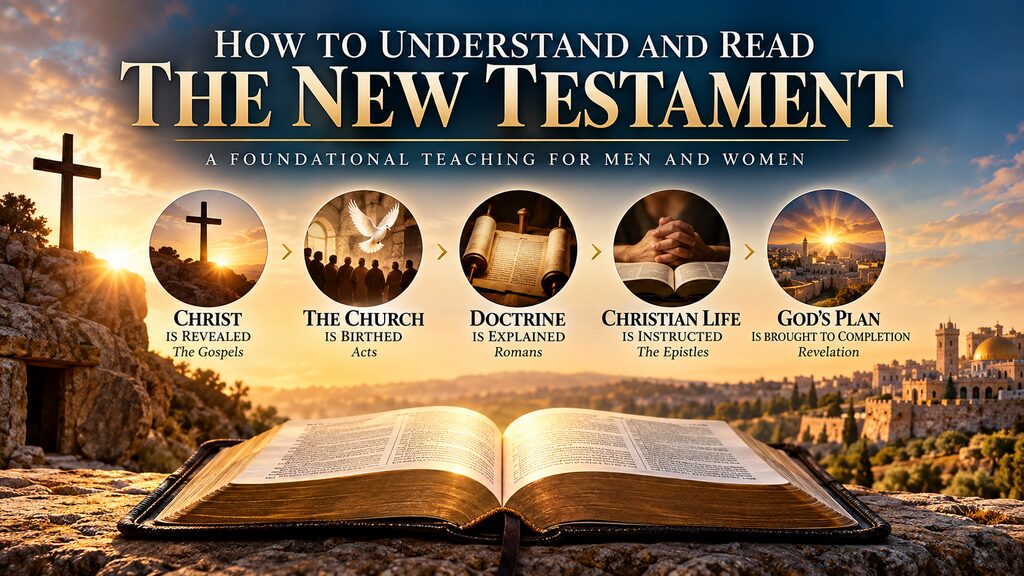
A Foundational Teaching for Men and Women
Why Many Christians Struggle When Reading the New Testament
For years, many believers have been told, “Just read the Bible.” And that is good advice. We should read it daily. We should read it carefully. We should read it prayerfully. But there is something important that is often missing from that advice.
We need to understand how the Bible fits together.
Before You Begin
Before exploring the New Testament, it is important to understand how the entire Bible fits together. PATH Ministry’s The Bible Map provides an overview of Scripture, helping readers understand how the Old and New Testaments connect within God’s unfolding plan of redemption. Once you’ve explored The Bible Map, return here to begin your New Testament study.
Begin Here
Many Christians sincerely love God’s Word but struggle to understand what they are reading. They move from one New Testament book to another without recognizing how those books relate to one another, why they were written, or how they contribute to God’s unfolding plan. As a result, they may understand individual verses without understanding the larger message. And when we lose sight of the larger message, confusion can follow.
One of the first things we need to recognize is that the New Testament is not arranged in the chronological order in which everything happened or was written. Its books are grouped in a meaningful literary and theological order.
That arrangement helps us see a progression:
- Christ is revealed — The Gospels
- The Church is birthed — Acts
- Doctrine is explained — Romans
- Christian life is instructed — The Epistles
- God’s plan is brought to completion — Revelation
This does not mean every book was written in that sequence, nor does it mean we must read them in that order. It means that understanding how these books relate to one another gives us a framework for studying Scripture.
The New Testament is not a random collection of religious writings. It is the inspired Word of God, revealing His purposes through Jesus Christ. And when believers begin to understand that larger picture, something important happens. Scripture becomes easier to follow. Doctrine becomes easier to understand. And the believer becomes better equipped to recognize truth and error.
Frameworks create stability. Stability creates discernment. And discernment produces mature believers. That is what we want to accomplish in this teaching.
Part 1 — Understanding the Bible and Its Arrangement
Before we walk through the New Testament, we need to understand two important terms: the Bible and the canon.
What Is the Bible?
The Bible is the inspired Word of God. It is not simply a collection of religious thoughts, historical accounts, or moral teachings. It is divine revelation.
Paul reminds Timothy:
“All Scripture is given by inspiration of God…” — 2 Timothy 3:16
The word inspiration speaks of Scripture being God-breathed. Although God used human authors, Scripture ultimately comes from Him.
The Bible contains 66 books, consisting of the Old Testament and the New Testament. Each book contributes to the revelation of God’s character, His purposes, His promises, and His plan of redemption.
What Is the Canon?
The word canon refers to the recognized collection of books accepted as inspired Scripture. This distinction is important.
The Church did not create Scripture. God inspired Scripture.
The recognition of the canon concerns identifying the writings that belong to God’s inspired Word.
When we speak about the arrangement of the New Testament, we are discussing how those recognized books have been organized. The familiar New Testament order groups books by their literary character and subject matter: the Gospels, Acts, the Epistles, and Revelation. That arrangement is useful because it helps us recognize how the different writings relate to one another. And that brings us to the heart of this teaching.
Part 2 — Following the Message of the New Testament
The easiest way to begin understanding the New Testament is to recognize what each major section contributes to God’s unfolding revelation.
We begin with Jesus Christ.
1. The Person and Work of Christ — The Four Gospels
Matthew, Mark, Luke, and John
The New Testament begins where our understanding of Christianity must begin:
With Jesus Christ Himself.
The Gospels are not merely collections of stories, miracles, or moral lessons. They are inspired testimonies concerning who Jesus is, why He came, what He taught, what He accomplished through His death, and what His resurrection means.
Everything that follows in the New Testament rests upon the Person and finished work of Christ.
You cannot understand grace without the Cross.
You cannot understand salvation without the Resurrection.
You cannot properly understand the Church without understanding the One who is its Head.
Each Gospel presents Jesus Christ from a particular perspective.
Matthew — Christ the King
Matthew presents Jesus as Israel’s promised Messiah, the rightful King who fulfills Old Testament prophecy. His Gospel emphasizes the Kingdom and demonstrates how Jesus fulfills the promises and expectations found in the Hebrew Scriptures.
Mark — Christ the Servant
Mark emphasizes Jesus as the Servant who came to minister, suffer, and give His life as a ransom. His account moves quickly, highlighting the actions and authority of Christ.
Luke — Christ the Son of Man
Luke emphasizes the humanity and compassion of Jesus Christ. He presents Jesus as the perfect Man and Savior whose ministry reaches beyond Israel to people of every background.
John — Christ the Son of God
John emphasizes the deity of Jesus Christ. He presents Jesus as the eternal Son of God, the source of life, and the One in whom salvation is found.
John explains the purpose of his Gospel:
“But these are written that you may believe that Jesus is the Christ, the Son of God, and that believing you may have life in His name.” — John 20:31
This is where our understanding must begin. Christianity is not primarily a system of ethics or religious performance. Christianity centers on a Person.
The gospel is not first about what we do for God. It is about what Jesus Christ has done for us.
Once we understand who Christ is and what He accomplished, we are prepared to understand what happened next.
2. The Birth and Transition of the Church — Acts
Acts of the Apostles
The book of Acts serves as the historical bridge between the Gospels and the Epistles. The Gospels record the earthly ministry, death, and resurrection of Jesus Christ. Acts shows the risen Christ continuing His work through the apostles by the power of the Holy Spirit.
Acts records the coming of the Holy Spirit at Pentecost, the preaching of the gospel, the growth of the early Church, persecution, miracles, missionary journeys, and the gospel moving outward from Jerusalem to the Gentile world.
Acts begins in Jerusalem and concludes with Paul preaching in Rome. That movement is significant. It shows the gospel going beyond its initial Jewish setting and reaching the nations. But there is something particularly important that every student of Scripture needs to understand.
Acts is primarily historical narrative. It tells us what happened during a unique period of transition.
This brings us to a fundamental principle of Bible interpretation.
Acts is descriptive, but not everything it describes is intended to become a permanent practice for every believer.
In other words, we must distinguish between what Scripture records and what Scripture commands. For example, Acts records miraculous signs, extraordinary events, and experiences associated with the establishment and expansion of the early Church. Those events truly happened.
But we should not automatically assume that every event recorded in Acts establishes a universal requirement for Christians today. We must consider the historical setting, the purpose of the event, and what the rest of Scripture teaches.
This is especially important when studying the ministry of the Holy Spirit, spiritual gifts, salvation, and the development of the Church. Many doctrinal misunderstandings arise when believers take an event from Acts and build an entire doctrine around it without considering the explanations given in the Epistles.
Acts shows us the Church being established. The Epistles help us understand the doctrine and responsibilities of the Church.
And that leads us naturally to Romans.
3. Understanding Salvation, Grace, and Doctrine — Romans
Romans
If Acts shows us the historical development of the early Church, Romans provides one of the clearest and most systematic explanations of the gospel and its implications for believers. Romans is a doctrinal anchor for understanding the Church age.
Paul explains mankind’s need for salvation, justification by faith, the believer’s relationship to sin, the work of the Holy Spirit, God’s faithfulness to Israel, and how Christians should live. But what makes Romans especially helpful is the way Paul develops his argument.
Romans is written with a powerful question-and-answer approach.
Paul presents a truth, anticipates the objection someone might raise, and then answers that objection. He is not simply presenting isolated theological statements. He is teaching believers how to reason from the truth of God’s Word.
Let’s follow that progression.
A. The Problem of Sin — Romans 1–3
Paul begins by establishing mankind’s guilt before God. He addresses the openly immoral person, the morally respectable person, and the religious Jew. His purpose is to demonstrate that no one can claim righteousness before God on the basis of personal goodness or religious privilege.
Paul raises questions such as:
- What advantage does the Jew have? (Romans 3:1)
- Is God unrighteous when He judges? (Romans 3:5)
- Are we better than they? (Romans 3:9)
His conclusion is unmistakable:
“There is none righteous, no, not one.” — Romans 3:10
Every person stands in need of God’s grace. Before we can properly appreciate salvation, we must understand why we need it.
Romans removes every hiding place.
B. The Meaning of Justification — Romans 3–5
Once Paul establishes mankind’s guilt, he explains God’s provision. Justification is God’s declaration that the believing sinner is righteous on the basis of Jesus Christ and His finished work. It is received by faith, apart from works.
Again, Paul anticipates objections.
Where is boasting? Is God the God of the Jews only? Does faith make the Law meaningless? What about Abraham?
Paul answers these questions to demonstrate that salvation has always depended upon God’s grace and promise rather than human achievement.
Justification is:
- By faith alone
- Apart from works
- Rooted in God’s promise
- Grounded in Christ’s finished work
This is where confusion clears.
This is where legalism dies.
This is where grace becomes glorious.
We are not saved because of what we accomplish for God. We are saved through faith in what Jesus Christ has accomplished for us.
C. Grace and Sanctification — Romans 6–8
Once Paul explains salvation by grace, another question naturally arises. If salvation is by grace and not by works, does that mean a believer is free to live however he chooses?
Paul anticipates that very objection:
“Shall we continue in sin that grace may abound?” — Romans 6:1
His answer is emphatic:
“Certainly not!” — Romans 6:2
Grace does not make sin acceptable. Rather, grace establishes a new relationship to sin through our identification with Jesus Christ. Paul then explains the believer’s struggle with the flesh and the importance of walking according to the Spirit.
Romans 8 brings us to the wonderful assurance of God’s love and faithfulness.
Paul asks:
“If God is for us, who can be against us?” — Romans 8:31
And:
“Who shall separate us from the love of Christ?” — Romans 8:35
The answer is clear. Nothing can separate the believer from the love of God in Christ Jesus. Our assurance rests upon God’s promises and Christ’s finished work, not upon changing emotions or circumstances.
Grace gives us a secure position in Christ, and that position becomes the foundation for spiritual growth.
D. What About Israel? — Romans 9–11
At this point, Paul addresses another important question.
If God made promises to Israel, and many within Israel rejected their Messiah, have those promises failed? Has God abandoned His people?
Paul asks directly:
“Has God cast away His people?” — Romans 11:1
His answer is unmistakable:
“Certainly not!”
Romans 9–11 explains God’s continuing faithfulness to His covenant promises.
Paul demonstrates that Israel’s present unbelief does not mean God has permanently rejected the nation. He explains the inclusion of Gentiles in God’s present work and points forward to Israel’s future restoration. This distinction is especially important.
The Church has not replaced Israel, and God’s promises to Israel have not been canceled.
God remains faithful to His Word.
Understanding these chapters protects us from confusing Israel and the Church or assuming that God’s covenant promises have somehow failed. Romans preserves both the greatness of God’s grace and the certainty of His faithfulness.
E. How Then Shall We Live? — Romans 12–16
After explaining these great doctrinal truths, Paul turns to Christian living.
He begins Romans 12 with the words:
“I beseech you therefore, brethren, by the mercies of God…” — Romans 12:1
Notice that word: therefore.
Paul is connecting how we live with what God has already done. Because of God’s mercy, grace, justification, and faithfulness, believers are called to live differently.
We are instructed to present ourselves to God, renew our minds, serve humbly, love sincerely, and walk in a manner consistent with our calling.
This is the proper relationship between doctrine and Christian living.
Belief first. Behavior second.
We do not live faithfully in order to earn salvation. We are called to live faithfully because we belong to Jesus Christ. That is why Romans is so important. It teaches us what God has done, what is true of us in Christ, and how those truths should influence our lives.
Romans trains believers to think biblically.
And believers who understand these truths are far less vulnerable to legalism, works-based salvation, emotional manipulation, and doctrinal confusion.
4. The Life and Order of the Church — The Epistles
Having established the foundation of the gospel, the remaining Epistles help us understand how believers and local churches are to live.
The word epistle simply means letter.
These inspired letters were written to churches and individuals to provide instruction, correction, encouragement, and doctrinal understanding. They address Christian living, spiritual growth, leadership, fellowship, suffering, false teaching, and the believer’s future hope.
Doctrine is not given merely to inform us. Doctrine is given to transform us.
The Epistles show us how the truth of Jesus Christ should shape our thinking, our conduct, and our relationships.
Paul’s Letters to the Churches
Each letter addresses particular needs while contributing to our understanding of Christian doctrine and living.
1 Corinthians — Corrects disorder within the church and provides instruction concerning holiness, spiritual gifts, worship, and the resurrection.
2 Corinthians — Explains the nature of Christian ministry, suffering, weakness, and spiritual authenticity.
Galatians — Defends justification by faith apart from works of the Law and warns against returning to legalism.
Ephesians — Explains the believer’s position in Christ, the mystery of the Church, and how our calling should influence our daily walk.
Philippians — Encourages Christ-centered living, humility, perseverance, and joy.
Colossians — Emphasizes the supremacy and sufficiency of Jesus Christ while warning against false spiritual systems.
1 Thessalonians — Encourages holy living and provides comfort concerning Christ’s return.
2 Thessalonians — Corrects misunderstandings concerning the Day of the Lord and encourages believers to remain steadfast.
Notice how these letters build upon the gospel. They do not introduce another way of salvation. They explain the implications of belonging to Jesus Christ. They teach us how to live in light of what God has already accomplished.
Paul’s Pastoral Epistles
The Pastoral Epistles provide instruction concerning church leadership, sound doctrine, and faithful ministry.
1 Timothy — Explains proper conduct, leadership qualifications, and the importance of protecting sound doctrine within the local church.
2 Timothy — Encourages faithfulness, endurance, and the responsibility to preach and preserve the Word of God.
Titus — Provides instruction concerning qualified leadership, sound teaching, and godly living.
These letters remind us that the local church is not free to operate according to personal preference or cultural trends. God has provided instruction concerning its leadership, doctrine, and conduct. A church that neglects sound doctrine becomes vulnerable to instability and worldly influence.
The General Epistles
The General Epistles provide additional instruction, warning, and encouragement for believers.
Hebrews — Demonstrates the superiority of Jesus Christ over the Old Covenant priesthood and sacrifices, emphasizing the sufficiency of His finished work.
James — Emphasizes practical spiritual maturity and the importance of putting God’s Word into practice.
1 Peter — Encourages believers to remain faithful through suffering and persecution.
2 Peter — Warns against false teachers and emphasizes spiritual growth and doctrinal stability.
1 John — Addresses fellowship with God, assurance, truth, love, and the danger of deception.
2 John and 3 John — Emphasize truth, love, discernment, and faithfulness in Christian fellowship.
Jude — Warns against apostasy and urges believers to contend earnestly for the faith.
Together, these letters remind us that Christianity is not simply about possessing biblical knowledge. It is about knowing Christ, understanding His Word, and allowing that truth to shape how we live. The Christian life is not built upon emotional experiences, religious performance, or human traditions.
It is grounded in the truth of God’s Word and lived through dependence upon Him.
5. The Completion of God’s Plan — Revelation
Revelation
The New Testament concludes with the book of Revelation. And this is where we see God’s prophetic purposes moving toward their ultimate fulfillment.
Revelation is often misunderstood because it contains visions, symbols, judgments, and prophetic events. Some believers avoid it because they find it intimidating. Others become so fascinated with prophetic details that they lose sight of its central message.
But Revelation was not given to create confusion.
It was given to reveal Jesus Christ and the certainty of God’s ultimate victory.
The book addresses the churches and then unfolds prophetic events involving divine judgment, the rise of Antichrist, the return of Jesus Christ, the establishment of His Kingdom, final judgment, and the eternal state. It also demonstrates that God’s promises concerning Israel and His Kingdom will be fulfilled.
Revelation contains symbols, but those symbols communicate real truth. They must be interpreted carefully within the context of Scripture. From a grammatical-historical and dispensational understanding, Revelation reveals real future events, including the visible return of Christ and His future earthly reign. But the central message is not speculation about world events.
The central message is that Jesus Christ will accomplish everything God has promised.
The Bible does not end with Satan victorious. It does not end with evil triumphing. It does not end with confusion or uncertainty. It ends with Christ reigning and God’s purposes fulfilled.
Revelation is not speculation. It is completion.
Part 3 — Why Understanding These Differences Matters
Now that we have walked through the major sections of the New Testament, we need to consider why this understanding is so important. The purpose is not simply to memorize the order of the books. The purpose is to learn how to read Scripture responsibly.
Every book of the Bible is inspired, but not every book communicates truth in exactly the same way. Historical narrative, doctrinal instruction, prophecy, and personal letters must be understood according to their context and purpose. When we ignore those differences, we can easily misunderstand what Scripture is teaching.
Understanding the Difference Between History and Doctrine
Consider Acts and Romans.
Acts records the historical development of the early Church. Romans explains foundational doctrines concerning salvation, grace, sanctification, and Christian living. Both are inspired Scripture. Both are necessary. But they serve different purposes.
When we read Acts, we should ask what happened, why it happened, and what that event meant within God’s unfolding plan. When we read Romans, we should pay close attention to the doctrinal explanations and instructions Paul gives to believers.
We should not automatically turn every historical event into a command or permanent pattern for the Church.
Acts records what happened. Romans helps explain what believers are to understand and how they are to live.
Recognizing that distinction helps protect us from building doctrine upon isolated experiences.
Understanding Israel and the Church
Another important distinction concerns Israel and the Church. The Gospels present Jesus Christ as Israel’s promised Messiah. Acts records the establishment and expansion of the Church. The Epistles explain the nature of the Church and the believer’s position in Christ. And Revelation points toward the fulfillment of God’s prophetic purposes.
These distinctions matter because God made specific promises to Israel that have not been canceled.
The Church participates in the blessings of salvation through Jesus Christ, but that does not mean the Church has replaced Israel or inherited every national promise made to Israel.
Paul addresses this directly in Romans 9–11.
Understanding this distinction helps us interpret prophecy, the Kingdom, and God’s future purposes without confusing what Scripture says about Israel with what it says about the Church. This is not about forcing a theological system onto the Bible.
It is about allowing Scripture to speak according to its context, its audience, and its intended meaning.
Understanding Grace and Christian Living
We must also recognize the difference between salvation and Christian growth. Salvation is received by grace through faith in Jesus Christ, apart from works. Christian growth concerns how believers respond to God’s grace through obedience, spiritual maturity, and dependence upon the Holy Spirit. Confusing these truths can lead to legalism and performance-based Christianity.
A believer may begin thinking that God’s acceptance depends upon how successfully he performs. But Scripture teaches that our standing before God rests upon Jesus Christ and His finished work.
Our Christian walk flows from that secure relationship. We do not obey to become saved. We obey because we have been saved.
Our position in Christ is the foundation for our walk with Christ.
This is why the order of Paul’s teaching is so meaningful. He often explains what God has done before instructing believers how they should live.
Doctrine comes first.
Practical application follows.
Understanding Prophecy Without Speculation
The same principle applies to prophecy.
Revelation should not be studied in isolation from the rest of Scripture. Its symbols, judgments, promises, and future events must be understood in light of the Old Testament prophets, the teachings of Jesus Christ, and the apostolic writings. Otherwise, believers may become consumed with timelines, current events, and speculation.
Prophecy was not given to produce fear or sensationalism. It was given to reveal God’s purposes and strengthen our confidence in His promises. Our hope is not found in our ability to predict tomorrow’s headlines.
Our hope is found in the certainty that Jesus Christ is coming again and God will fulfill His Word.
Part 4 — Becoming a Faithful Student of Scripture
This brings us to a very practical question.
What kind of believer should this understanding produce?
The answer is found in the example of the Bereans.
Acts 17:11 describes believers who received the Word with readiness and searched the Scriptures daily to determine whether what they were being taught was true.
They did not reject teaching simply because it was unfamiliar. But neither did they accept teaching merely because someone spoke with confidence or authority. They examined the Scriptures. That is the attitude every faithful student of God’s Word should develop.
We must learn to test what we hear by what God has written.
And doing that requires more than knowing a few familiar verses. It requires understanding context. We need to ask who is speaking, who is being addressed, what is happening, and how the passage fits into the larger message of Scripture.
We also need to recognize whether we are reading historical narrative, doctrinal instruction, prophecy, or practical exhortation. These are not complicated rules reserved for scholars. They are basic habits that help ordinary believers read the Bible faithfully.
Why a Biblical Framework Produces Stability
A believer without a sound understanding of Scripture can become vulnerable to confusion. He may be influenced by persuasive personalities, emotional experiences, popular teachings, or isolated Bible verses taken out of context.
But a believer who understands God’s Word develops a foundation. He begins to recognize when teaching contradicts the gospel of grace.
He understands why salvation cannot be earned through religious performance.
He recognizes the importance of distinguishing Israel from the Church.
He becomes more careful about building doctrine from historical events.
And he learns to approach prophecy with confidence rather than fear.
This does not mean a mature believer will understand every passage or have an immediate answer to every question. We are all continuing to learn. But spiritual maturity produces something valuable.
Discernment.
Discernment is not suspicion of everyone who teaches differently. It is the growing ability to distinguish truth from error through a sound understanding of Scripture.
That is why doctrine matters.
Not because we want to win arguments.
Not because we want to appear knowledgeable.
And certainly not because we want to become proud. We study doctrine because we want to know Christ, understand His Word, and live faithfully before Him.
Truth should produce humility, not arrogance.
The more we understand God’s grace, the more we should appreciate how much we depend upon Him. The more we understand His faithfulness, the more confidently we should trust His promises. And the more we understand our position in Christ, the more we should desire to walk in a manner worthy of our calling.
That is the purpose of becoming a faithful student of Scripture.
Part 5 — A Practical Reading Path Through the New Testament
At this point, someone may reasonably ask:
“Where should I begin?”
There is no requirement that every believer read the New Testament in the same order. Every book is inspired and profitable.
However, for someone who wants to develop a clearer understanding of how the New Testament fits together, I would recommend the following reading path.
Begin with John.
John helps us understand who Jesus Christ is and why believing in Him matters. It places the Person and deity of Christ at the center of our attention.
Then read Mark.
Mark gives us a clear picture of Christ’s earthly ministry, His service, His suffering, and His mission.
Next, read Acts.
Acts shows what happened following the resurrection and ascension of Christ. It introduces the coming of the Holy Spirit, the establishment of the Church, and the spread of the gospel.
Then spend meaningful time in Romans.
Romans explains the gospel, justification, grace, sanctification, assurance, God’s faithfulness to Israel, and Christian living. Do not rush through Romans. Pay attention to the questions Paul asks and how he answers them.
Next, read Ephesians and Philippians.
Ephesians helps us understand our position in Christ and how that position should influence our daily walk.
Philippians encourages us to live with humility, joy, and a Christ-centered perspective.
Then read 1 Thessalonians.
This letter introduces important truths concerning Christ’s return while encouraging believers to live faithfully in anticipation of Him.
Next, read Hebrews.
Hebrews helps us understand the superiority and sufficiency of Jesus Christ, particularly in relation to the Old Covenant.
Finally, read Revelation.
With a stronger understanding of Christ, salvation, the Church, and God’s promises, you will be better prepared to approach Revelation with confidence and discernment.
This reading path is not intended to replace reading the entire New Testament. It is simply a starting point for building understanding. As you grow, continue reading all the books of Scripture and examining how they relate to one another.
And remember something important.
The goal is not simply to finish reading the Bible. The goal is to understand what God has revealed.
Read slowly enough to think.
Ask questions.
Pay attention to context.
Compare Scripture with Scripture.
And when you encounter something difficult, do not become discouraged. Keep studying. God’s Word is worth the effort.
Conclusion — A Framework Creates Stability
God did not give us the New Testament as a scattered collection of unrelated religious writings. He gave us His inspired Word, revealing His purposes through Jesus Christ. And as we begin to understand how the New Testament fits together, we recognize a wonderful progression.
Christ is revealed.
The Gospels introduce us to the Person and work of Jesus Christ.
The Church is birthed.
Acts records the establishment and early development of the Church as the gospel spreads.
Doctrine is explained.
Romans provides a foundation for understanding salvation, grace, and the believer’s relationship with God.
Christian life is instructed.
The Epistles teach us how to live, grow, serve, and remain faithful.
God’s plan is brought to completion.
Revelation points us toward the fulfillment of God’s promises and the ultimate victory of Jesus Christ.
When we understand these distinctions, Scripture begins to fit together more clearly. We become better equipped to distinguish historical events from doctrinal instructions. We learn to recognize the difference between Israel and the Church. We understand salvation by grace through faith and the importance of Christian growth. And we approach prophecy with confidence in God’s promises rather than fear or speculation.
But above all, we keep Jesus Christ at the center.
Not the Church.
Not spiritual gifts.
Not prophecy charts.
Not religious performance.
Jesus Christ.
Everything begins with Him, and everything ultimately points to the fulfillment of God’s purposes in Him.
A Final Encouragement for Faithful Students of Scripture
My encouragement is simple. Do not be satisfied with merely knowing familiar Bible verses. Learn to understand the Bible as a whole. Learn why the books were written, who they were written to, and how they fit into God’s unfolding plan.
Become the kind of believer who searches the Scriptures carefully, examines what is taught, and stands firmly upon the truth of God’s Word.
A believer grounded in Scripture becomes difficult to deceive.
They are not easily tossed around by popular teachings.
They are not carried away by emotional experiences.
They are not easily impressed by charismatic personalities or persuasive arguments.
They become stable, discerning, and spiritually mature.
And that kind of believer becomes dangerous to the enemy. Not because of personal strength or superior knowledge. But because they know Christ, they know His Word, and they have learned to stand upon the truth.
Frameworks create stability. Stability creates discernment. And discernment produces mature believers.