
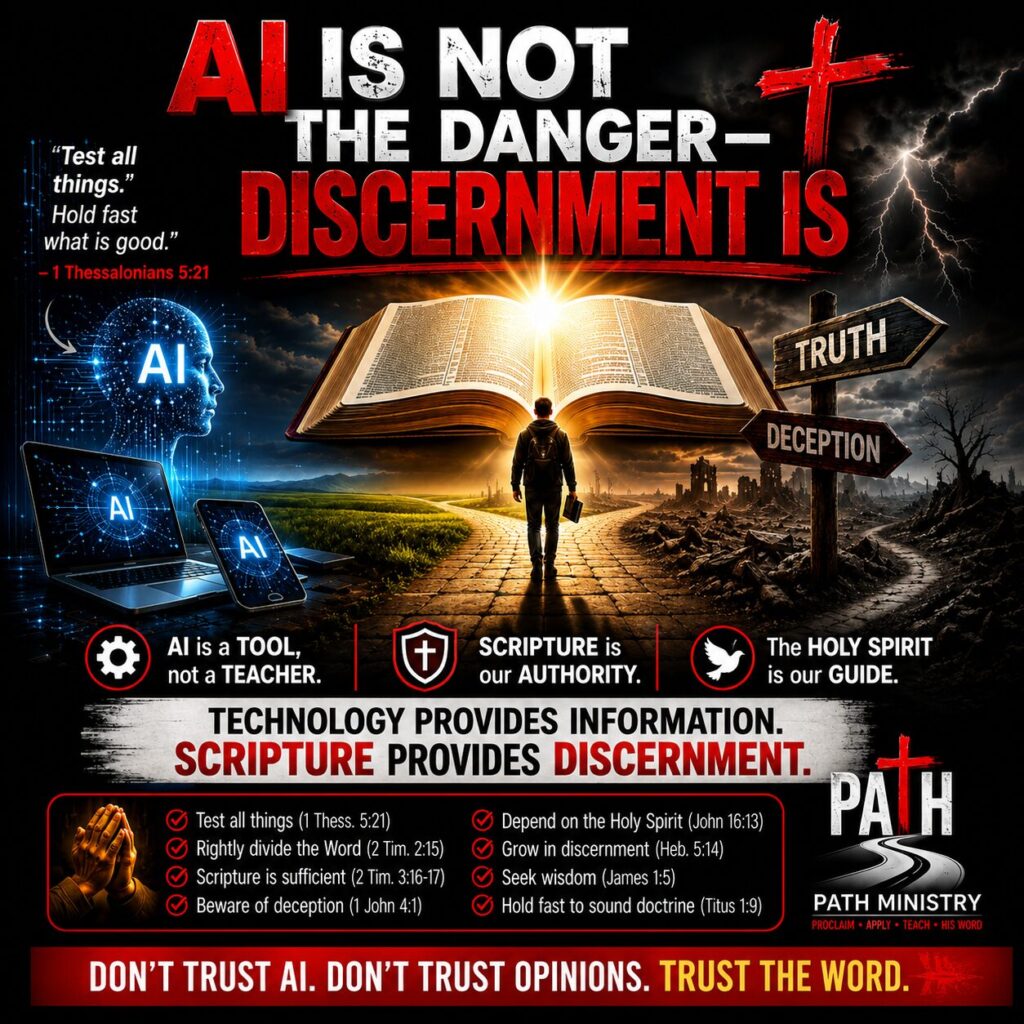
AI and Discernment
Artificial Intelligence has become one of the most discussed and controversial technologies of our time. Some embrace it without question. Others reject it out of fear. As Christians, however, we are called to do neither.
The issue is not whether AI exists or whether it will continue to shape the world around us. The issue is whether believers possess the biblical discernment necessary to navigate it wisely.
Like every major technological advancement before it, AI has the potential to amplify both truth and error. It can be a useful tool, but it can never replace the authority of Scripture, the guidance of the Holy Spirit, or the responsibility each believer has to test all things against the Word of God.
The thoughts that follow are not intended to promote fear or blind trust, but rather to encourage thoughtful, biblical discernment in a rapidly changing world. Click below to read the full message.
Click Here to Read the Full Message
AI IS NOT THE DANGER — DISCERNMENT IS
Christians are asking an important question right now:
“Should believers use AI?”
- Some say absolutely yes.
- Others say absolutely no.
But I believe the real issue is deeper than the technology itself. The greatest danger is not artificial intelligence. The greatest danger is spiritual instability combined with artificial intelligence.
1. A Foundation Must Exist Before the Tool
Before I ever used AI, I had already come to convictions about truth through:
- the Word of God,
- the help of faithful theology,
- sound biblical interpretation,
- and the illuminating work of the Holy Spirit.
That foundation matters.
2. Discernment Matters More Than Ever
Because AI can generate almost any theological position imaginable:
- sound doctrine,
- false doctrine,
- prosperity theology,
- replacement theology,
- hyper-charismatic teaching,
- liberal theology,
- legalism,
- emotionalism,
- and everything in between.
And it can all sound intelligent. That is why discernment is more important now than ever before.
A believer who does not know:
Why they believe what they believe; how to rightly divide Scripture; how to interpret context; the difference between descriptive and prescriptive passages; or how theology fits together across the whole counsel of God, can be easily influenced by confident-sounding error.
3. AI Is Already Part of Everyday Life
At the same time, Christians must also recognize something important:
AI is not going away. And many people criticizing AI do not even realize how much AI they already use every single day.
- Search engines use AI.
- Phones use AI.
- Navigation systems use AI.
- Email filtering uses AI.
- Social media algorithms use AI.
- Online shopping recommendations use AI.
- Voice assistants use AI.
Artificial intelligence is already deeply woven into modern life.
I remember when my boss first told me: “AI is the future. We need to start using it.” At first, I resisted the idea. I thought: “What is AI going to show me that I don’t already know?” But over time, I realized something: AI became a useful tool in my work.
- It helps organize thoughts.
- Improve communication.
- Assist with writing.
- Clarify ideas.
- Streamline workflow.
- And help gather information more efficiently.
But here is the difference:
- I do not blindly trust it.
- I already have experience.
- I already have discernment.
- I already have trusted resources for verification.
- I already know the importance of testing information rather than simply accepting everything presented to me. That is the key.
As stated before; “Artificial intelligence is already deeply woven into modern life.”
4. AI Is a Tool, Not an Authority
- AI does not replace the Holy Spirit.
- AI does not illuminate Scripture.
- AI does not produce spiritual maturity.
- AI does not sanctify believers. The Holy Spirit does.
Scripture remains the authority.
- Not algorithms.
- Not technology.
- Not emotionally persuasive language.
AI is a tool. And like every tool throughout history, it can amplify both truth and error.
A hammer can build a home or break a window.
The internet has spread both sound doctrine and deception.
- Television did the same.
- Social media did the same.
AI is simply the newest amplifier.
5. The Real Danger is Spiritual Instability
And perhaps one of the greatest concerns is this: people who already have weak theology or unstable doctrine may use AI to reinforce error rather than pursue truth.
If someone approaches Scripture through: poor hermeneutics, man-centered theology, experience-driven Christianity, misuse of the book of Acts, or emotional sensationalism, AI can rapidly magnify those problems. But for the believer grounded in Scripture, anchored in sound doctrine, dependent upon the Holy Spirit, and committed to truth, AI can simply become another resource, not a replacement for God.
6. The Church Must Recover Discernment
The Bible says that Bereans were commended because they searched the Scriptures daily to test what they heard. That responsibility has not changed. Christians should never surrender discernment to technology.
We still must: pray, study, test everything, rightly divide the Word, and remain submitted to the authority of Scripture.
The issue is not whether AI exists. The issue is whether the Church still knows how to discern truth.
Perhaps the greatest danger of AI is not the technology itself, but the growing number of people unwilling to test what they are hearing by the Word of God.
Many will read messages like this and never take the time to open the Scriptures for themselves.
- Never study the context.
- Never pray for discernment.
- And never test what is being said.
That is the real danger.
Because a person who will not labor in the Word has no stable foundation for discerning truth from error.
SCRIPTURE REFERENCES FOR TESTING AND DISCERNMENT
The Authority and Sufficiency of Scripture:
1. Test Everything by Scripture
Acts 17:11
The Bereans did not blindly accept what they were taught. They searched the Scriptures daily to verify whether the things they heard were true.
2. Rightly Handle the Word of God
2 Timothy 2:15
Truth requires diligence. Believers are called to carefully study and accurately handle God’s Word rather than relying on assumptions, traditions, or opinions.
3. Scripture Is the Final Authority
2 Timothy 3:16-17
The Bible is God-breathed and sufficient for teaching, correction, instruction, and spiritual maturity. Scripture remains our ultimate authority—not technology, personalities, or experiences.
4. Test Everything You Hear
1 Thessalonians 5:21
Christians are commanded to examine teachings, claims, and ideas carefully, holding fast only to what is true and biblically sound.
5. Beware of Spiritual Deception
1 John 4:1
Not every spiritual claim, teacher, or message comes from God. Believers must exercise discernment and test what they hear.
6. Depend on the Holy Spirit for Truth
John 16:13-15
The Holy Spirit guides believers into truth. He does not replace Scripture, nor does technology replace Him. Spiritual understanding ultimately comes from God.
7. Grow into Spiritual Discernment
Hebrews 5:14
Discernment is developed through spiritual maturity and consistent exposure to God’s Word. Mature believers learn to distinguish between truth and error.
8. Renew Your Mind
Romans 12:1-2
Yielded believers are transformed through the renewing of their minds by God’s truth rather than being shaped by the thinking of the world around them.
9. Seek Wisdom from God
James 1:5
When faced with difficult questions, confusing information, or competing voices, believers should seek wisdom from God, who gives generously to those who ask.
10. Hold Fast to Sound Doctrine
Titus 1:9
Strong doctrine protects believers from deception and equips them to recognize and refute error when it appears.
The issue is not whether AI exists. The issue is whether believers are willing to do the work of studying God’s Word, seeking the Holy Spirit’s guidance, and developing biblical discernment.
Technology can provide information instantly. Discernment still requires Scripture, prayer, humility, and complete yielded obedience.