
Stand Firm in the Truth in an Age of Apostasy
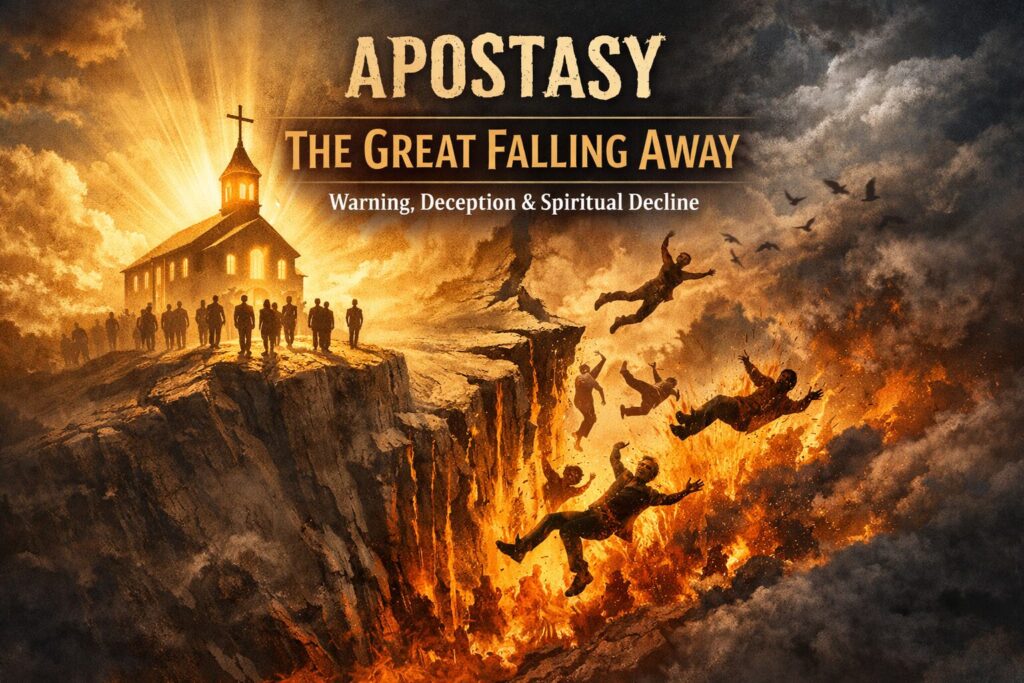
Scripture repeatedly warns that in the last days many will turn away from the truth. What begins as indifference toward God can eventually lead to open rejection of Christ and His Word. The Bible calls this tragic departure apostasy—a falling away from the truth that was once professed.
In an age of increasing deception, the church must return to the authority of Scripture and the sufficiency of Christ.
Apostasy – The Great Falling Away (Click to Read)
Understanding the Biblical Warning
The Greek word for apostasy is ἀποστασία (apostasia).
It comes from the verb ἀφίστημι (aphistēmi), which means to stand away from, to depart, or to withdraw. In a religious context, apostasia refers to a defection or departure from the truth of the faith.
Scripture warns that in the last days there will be a growing departure from biblical truth.
“Let no one deceive you by any means; for that Day will not come unless the falling away comes first…” — 2 Thessalonians 2:3 (NKJV)
This falling away refers to a widespread abandonment of biblical truth by many who once identified with the Christian faith but ultimately reject it.
The Warning of Hebrews 10:26–27
“For if we sin willfully after we have received the knowledge of the truth, there no longer remains a sacrifice for sins, but a certain fearful expectation of judgment.” — Hebrews 10:26–27…… This passage is one of the strongest warnings in the New Testament and must be interpreted carefully.
The writer of Hebrews is warning about the danger of willfully rejecting the truth of Christ after fully understanding it. The phrase “knowledge of the truth” refers to a clear understanding of the gospel and Christ’s finished sacrifice.
If a person knowingly rejects Christ after receiving this knowledge, there remains no other sacrifice for sins, because:
Christ’s sacrifice is the only sacrifice for sin that God has provided.
Rejecting Him leaves a person with no other means of salvation.
This does not mean God’s grace is insufficient. Rather, it emphasizes the seriousness of rejecting the only remedy God has provided.
What Does “Willful Sin” Mean Here?
The passage is not referring to ordinary struggles with sin that believers experience.
Every Christian still battles the flesh.
Instead, the warning concerns a deliberate and persistent rejection of Christ and His sacrifice after understanding the truth of the gospel. This is why the passage describes the result as: “a fearful expectation of judgment.”
The warning is directed toward those who come close to the truth, understand it, but ultimately reject Christ.
Is This Apostasy?
Yes. Hebrews 10:26–27 describes the danger of apostasy.
Apostasy refers to the deliberate abandonment of the truth after having understood it. This does not describe a believer losing salvation. Scripture is clear that eternal life is secure for those who truly believe in Christ.
“He who hears My word and believes in Him who sent Me has everlasting life, and shall not come into judgment, but has passed from death into life.” — John 5:24
Rather, apostasy describes those who:
- hear the truth
- understand the gospel
- identify with the Christian community
- but ultimately reject Christ.
As the apostle John wrote:
“They went out from us, but they were not of us.” — 1 John 2:19
Their departure revealed that they never truly trusted Christ.
Understanding Apostasy Through Jesus’ Parables
Two parables in Matthew 13 help explain how apostasy occurs.
The Parable of the Sower
Jesus explained that the seed represents the Word of God, but people respond differently to it.
Some hear the Word and produce fruit:
- some one hundredfold
- some sixty
- some thirty.
Others receive the message temporarily but never develop genuine faith.
Some fall away because of:
- persecution
- worldly cares
- deception.
This parable of the Sower shows that not everyone who hears the gospel truly receives it.
The Parable of the Wheat and the Tares
Jesus taught that the kingdom of heaven is like a field where both wheat and tares grow together.
- The wheat represents true believers.
- The tares represent those who appear to belong but do not truly belong.
- The master instructs that both remain together until the harvest.
At the end of the age:
- the wheat will be gathered into the barn
- the tares will be gathered and burned.
This explains why apostasy appears within the visible church. Not everyone who professes faith truly possesses faith.
Apostasy and the Book of Revelation
The warnings of Hebrews also echo in the book of Revelation. Jesus warned several churches about spiritual decline and compromise.
Ephesus — Losing First Love
“You have left your first love.” — Revelation 2:4
Christ warned that their lampstand could be removed if they did not repent.
Pergamum — Tolerating False Teaching
“Repent, or else I will come to you quickly and will fight against them with the sword of My mouth.” — Revelation 2:16
False doctrine had entered the church.
Laodicea — Lukewarm Faith
Because you are lukewarm… I will vomit you out of My mouth.” — Revelation 3:16
Spiritual complacency had replaced devotion.
The Final Judgment
Revelation ultimately reveals the final separation between those who belong to Christ and those who reject Him.
“Anyone not found written in the Book of Life was cast into the lake of fire.” — Revelation 20:15
This final judgment parallels the warning of Hebrews about the fearful expectation of judgment for those who reject Christ.
The Biblical Call
The warnings about apostasy are not meant to create fear for believers.
They are meant to encourage:
- discernment
- faithfulness
- perseverance in truth
Jesus said:
“My sheep hear My voice, and I know them, and they follow Me.” — John 10:27
Those who truly belong to Christ continue to follow Him.
In a world filled with competing voices and increasing deception, believers must anchor themselves in the authority of Scripture and the voice of the Shepherd.
An Invitation to Receive Christ
The warnings about apostasy remind us of a sobering truth: it is possible to be around the things of God and yet never truly belong to Him. A person may know the language of Christianity, attend church, or admire the teachings of Jesus while never personally placing their trust in Him.
The Bible declares that salvation is not earned through good works, religious effort, or moral improvement. It is a gift that God offers freely through His Son.
Scripture says:
“For by grace you have been saved through faith, and that not of yourselves; it is the gift of God, not of works, lest anyone should boast.” — Ephesians 2:8–9
Every person has sinned and stands in need of forgiveness (Romans 3:23). Because of His great love, God sent His Son, Jesus Christ, who lived a sinless life and died on the cross to pay the penalty for our sins. Three days later, He rose from the dead, proving that His sacrifice was accepted and that He alone has the power to give eternal life.
Jesus said:
“I am the way, the truth, and the life. No one comes to the Father except through Me.” — John 14:6
Salvation comes when a person places their trust in Jesus Christ alone—believing that He died for their sins and rose again, and relying on Him as their only hope for forgiveness and eternal life.
If you have never trusted Christ, you can come to Him today. God invites you to believe the gospel and receive the gift of eternal life.
“Whoever calls on the name of the Lord shall be saved.” — Romans 10:13
You can turn to Him right now in simple faith, trusting in Christ and His finished work on the cross. You may express your faith to God in a prayer like this:
Heavenly Father, I know that I am a sinner and cannot save myself. I believe that Jesus Christ died for my sins and rose again. Today I place my trust in Him alone as my Savior. Thank You for Your grace and for the gift of eternal life through Jesus Christ. Amen.
Salvation is not found in religion, but in a relationship with the risen Savior.